











A poor kombucha setup can cause weak flavor, unstable fermentation, contamination risk, or slow production. For home brewers, that is frustrating. For a business, it costs money. The solution is to choose the right equipment for your batch size, hygiene needs, and growth plan.
Kombucha brewing equipment includes the tools and vessels used to brew sweet tea, ferment it with SCOBY culture, monitor pH and temperature, add flavoring, bottle or keg the beverage, and maintain clean production. Basic home kits may use glass jars and bottles, while commercial kombucha production usually requires stainless steel tanks, sanitary fittings, CIP cleaning, cooling, filtration, and packaging systems.

Executive Summary
Kombucha brewing equipment ranges from a simple home kit with a jar, cloth lid, SCOBY, tea, sugar, pH strip, and bottles to professional-grade stainless steel tanks and packaging lines.
Kombucha is made by fermenting sweet tea with a SCOBY, a symbiotic culture of bacteria and yeast; Colorado State University explains that the culture acidifies the tea and helps minimize contamination.
Finished kombucha is commonly acidic. Colorado State University states that safe consumption requires pH below 4.2 but not lower than 2.5.
Kombucha Brewers International describes kombucha as a fermented tea beverage that typically has a pH range of 2.3 to 3.8 and naturally contains organic acids, trace alcohol, and some carbonation.
In the United States, TTB alcohol regulations do not apply only when kombucha is never at or above 0.5% ABV during production, bottling, or after bottling.
For B2B projects, the right system should match batch volume, fermentation cycle, hygiene design, cooling needs, packaging format, space, utilities, and future expansion.
Article Outline
What Is Kombucha Brewing Equipment?
What Equipment Do You Need to Brew Kombucha at Home?
What Is Included in a Basic Kombucha Brewing Kit?
What Equipment Is Needed for Commercial Kombucha Production?
Why Are Stainless Steel Kombucha Tanks Important for Scaling Up?
How Do You Control Fermentation, pH, and Temperature?
What Bottling, Kegging, and Packaging Equipment Do You Need?
How Do Cleaning, Sanitation, and CIP Affect Kombucha Quality?
Home Kit vs Commercial Kombucha Brewery System: What Is the Difference?
How Should B2B Buyers Choose the Right Kombucha Brewing Equipment Supplier?
What Is Kombucha Brewing Equipment?
Kombucha brewing equipment refers to the tools, vessels, tanks, and accessories used to make kombucha from tea, sugar, water, and kombucha culture. At a basic level, it helps you brew sweet tea, cool it, add SCOBY and starter liquid, allow fermentation, check pH, add flavor, and package the finished beverage.
For home brewing, the setup can be very simple. A glass jar, cloth cover, rubber band, pH strip, thermometer, funnel, and bottle may be enough for a small batch. For commercial kombucha, the equipment becomes more serious. You may need a stainless steel tank, sanitary pump, filter, cooling system, CIP cleaning unit, flavoring tank, carbonation control, and filling line.
In my work with beverage equipment projects, I often tell buyers this: kombucha is simple in theory, but professional production is not casual. The process must protect the scoby, control the fermentation environment, and keep every product contact surface clean.
What Equipment Do You Need to Brew Kombucha at Home?
For a home brewer, the basic goal is to brew a safe, clean, and tasty batch in a small volume. Most people start with a 1 gallon glass jar, a breathable cloth lid, tea, sugar, starter liquid, a SCOBY, and bottles for secondary fermentation.
Colorado State University explains that SCOBY and liquid are added to a food-grade vessel of brewed, cooled, sugar-sweetened tea, then lightly covered and fermented at room temperature, often for 7–10 days but sometimes longer.
A simple home setup may include:
| Home Kombucha Tool | Purpose |
|---|---|
| Glass jar | Main fermentation vessel |
| Cloth lid or coffee filter | Keeps dust and insects out while allowing airflow |
| Rubber band | Holds the cover in place |
| Tea kettle | Used to brew tea |
| Thermometer | Helps check cooling and room temperature |
| pH strips or meter | Helps monitor acidity |
| Funnel | Helps transfer liquid into bottles |
| Swing top bottles | Used for carbonation and serving |
| Fine filter | Removes loose tea or fruit pieces |
| Labels | Helps track batch date and flavor |
For home use, glass jars are common because they are easy to clean and easy to inspect. Michigan State University Extension notes that because kombucha has low pH, it is recommended to make and store it in glass containers or food-grade containers to reduce chemical hazard risks from unsuitable materials.
What Is Included in a Basic Kombucha Brewing Kit?
A basic kombucha brewing kit usually includes the essential items needed to start brewing kombucha. It may include a jar, SCOBY, starter liquid, tea, sugar, cloth cover, rubber band, pH strips, and instructions. Some kits may also include bottles, flavoring ideas, a thermometer, or a small filter.
A good kit should make the process easy for beginners. It should help the brewer understand the basics: make sweet tea, cool it, add the culture, cover the jar, wait for fermentation, measure pH, taste carefully, and bottle only when the beverage is ready.
For small users, a kit is enough. For a brand or café, a kit is not enough. Once the goal is to produce kombucha for sale, the process needs stronger equipment, better records, and repeatable control. That is when buyers move from jars and bottles to tanks, pumps, valves, temperature control, and packaging systems.
What Equipment Is Needed for Commercial Kombucha Production?
Commercial kombucha production needs more than a bigger jar. It needs a controlled process. A professional setup may include tea brewing equipment, sugar mixing tanks, cooling equipment, fermentation tanks, sanitary transfer pumps, filters, blending tanks, flavoring tanks, carbonation equipment, kegging or bottling lines, and cleaning systems.
A practical commercial kombucha production flow may look like this:
| Production Stage | Equipment Needed | Main Purpose |
|---|---|---|
| Tea brewing | Kettle or hot water system | Extract tea flavor |
| Sugar mixing | Mixing tank | Dissolve sugar evenly |
| 冷却 | Heat exchanger or cooling tank | Cool sweet tea before culture addition |
| Primary fermentation | Fermentation tank | Ferment tea with SCOBY and starter |
| pH monitoring | pH meter or strip | Measure acidity |
| Flavoring | Blending tank | Add fruit, juice, herbs, or botanicals |
| Filtration | Filter or screen | Remove fruit particles or loose solids |
| Carbonation | Carbonation stone or pressure tank | Add or manage bubbles |
| Packaging | Bottle filler, kegging system, canning line | Prepare final product |
| クリーニング | CIP system | Clean tanks and pipelines |
Kombucha Brewers International describes kombucha as a fermented beverage made with tea leaves, water, natural sweetener, and SCOBY or pellicle; the organization also notes that pH and fermentation characteristics are part of the beverage identity.
As a professional brewery, kombucha, winery, distillery, and beverage equipment manufacturer, we usually start by asking buyers about capacity, product style, packaging format, and market rules. A 50-liter pilot system and a 5,000-liter commercial kombucha line require very different planning.
Why Are Stainless Steel Kombucha Tanks Important for Scaling Up?
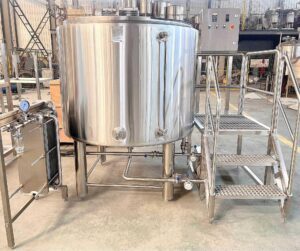
When a kombucha business grows, stainless steel equipment becomes important. A stainless steel kombucha tank is stronger, easier to clean, more durable, and better suited for professional production than many small containers.
A commercial fermenter can be designed with sanitary fittings, temperature control, sampling valves, spray balls, manways, and bottom outlets. These features help the brewer monitor, clean, and transfer product more efficiently.
For kombucha, material selection matters because the beverage is acidic. Food-grade stainless steel is commonly used in beverage plants because it supports hygienic design and long service life. However, buyers should confirm material grade, weld quality, internal polishing, fitting standards, and chemical compatibility before ordering.
Common Stainless Steel Kombucha Tank Features
| Feature | Why It Matters |
|---|---|
| 304 stainless steel | Common beverage-grade material |
| Internal polishing | Helps reduce residue and cleaning difficulty |
| Sanitary fittings | Supports clean transfer and easy connection |
| Sampling valve | Allows testing without opening the tank |
| Spray ball | Supports CIP cleaning |
| Cooling jacket | Helps manage fermentation temperature |
| マンウェイ | Allows access for inspection and cleaning |
| Bottom outlet | Helps drain product and cleaning solution |
| Thermowell | Supports temperature monitoring |
For B2B buyers, the right equipment is not simply the largest tank. It is the tank that matches fermentation style, cleaning method, building height, floor load, batch size, utility supply, and packaging plan.
How Do You Control Fermentation, pH, and Temperature?
Kombucha fermentation is driven by bacteria and yeast in the culture. The yeast helps break down sugar, while bacteria help create beneficial acids. The result is a tart, lightly sweet, acidic beverage with complex flavor.
pH control is one of the most important safety and quality checks. Colorado State University states that safe consumption requires pH below 4.2 but not lower than 2.5. Pennsylvania’s kombucha brewing guidance also states that producers of unpasteurized bottled kombucha or other fermented beverages should aim for pH 4.2 or below and monitor pH as a preventive control.
Temperature also affects fermentation speed and flavor. If the environment is too cold, fermentation may be slow. If it is too warm, the brew may acidify too quickly or develop unwanted character. For commercial systems, temperature control can help create a more consistent and high-quality kombucha product.
Kombucha Monitoring Checklist
| Control Point | What to Measure | Why It Matters |
|---|---|---|
| pH | Acidity level | Helps manage safety and taste |
| Temperature | Fermentation environment | Affects fermentation speed |
| Time | Batch duration | Helps repeat flavor profile |
| Sugar level | Remaining sweetness | Affects taste and carbonation |
| Alcohol | ABV level | Important for regulatory compliance |
| Aroma and taste | Sensory quality | Confirms product target |
| Visual condition | Mold, contamination, SCOBY health | Helps catch problems early |
In the United States, alcohol level matters because kombucha at or above 0.5% ABV can fall under alcohol regulatory requirements; TTB explains that regulations do not apply only when kombucha is never at or above 0.5% ABV during production, bottling, or after bottling.
What Bottling, Kegging, and Packaging Equipment Do You Need?
After fermentation, kombucha may be filtered, flavored, carbonated, and packaged. Small brewers often use swing top bottles. Larger operations may use bottle fillers, canning lines, kegging systems, or bag-in-box solutions.
Colorado State University notes that fruit juice or other flavorings may be added after fermentation, and the beverage can then be carbonated for a bubbly character. This is where packaging choices become important.
For small batches, bottles may work well. For cafés, restaurants, and taprooms, kegging can reduce packaging waste and support draft service. For retail brands, bottles or cans may be better for distribution.
Packaging Options for Kombucha
| Packaging Format | Best Use | Key Consideration |
|---|---|---|
| Swing top bottles | Home and small craft batches | Pressure buildup must be managed |
| Glass bottles | Retail and premium products | Breakage and shipping weight |
| Aluminum cans | Retail and distribution | Requires suitable filling line |
| Kegs | Taproom, restaurant, café | Needs draft system and cold storage |
| PET bottles | Some regional markets | Must match pressure and food safety needs |
Kombucha packaging must manage carbonation and ongoing fermentation. If fermentation continues strongly after bottling, pressure can build. This is why pH, sugar, temperature, alcohol, carbonation, and cold storage all need professional control in commercial operations.
How Do Cleaning, Sanitation, and CIP Affect Kombucha Quality?
Cleaning is not optional. Kombucha is acidic, alive, and sensitive to unwanted contamination. Poor cleaning can damage flavor, shorten shelf life, and create safety issues.
For small-batch kombucha making, cleaning may involve washing jars, funnels, bottles, and cloth covers carefully. For commercial operations, cleaning usually requires CIP, sanitary piping, spray balls, pumps, and proper cleaning procedures.
A professional-grade system should reduce dead corners, rough welds, and hard-to-clean surfaces. This is why tank design, valve selection, hose quality, gasket material, and piping layout matter. A beautiful tank with poor sanitary design can still create problems.
CIP and Cleaning Design Checklist
| Cleaning Item | Why It Matters |
|---|---|
| Spray ball coverage | Helps clean tank surfaces |
| Smooth welds | Reduces residue buildup |
| Sanitary valves | Improves cleanability |
| Drainability | Prevents standing liquid |
| Correct chemical use | Protects stainless steel |
| Separate tools | Reduces cross-contamination |
| Cleaning records | Supports quality control |
| Inspection access | Helps verify cleaning results |
As a beverage equipment manufacturer, we design systems with cleaning in mind. A good tank should not only hold product. It should also be easy to clean, inspect, and maintain.
Home Kit vs Commercial Kombucha Brewery System: What Is the Difference?
A home kit is designed for learning and personal use. A commercial kombucha brewery system is designed for repeatable production, controlled quality, and business operation.
| 項目 | Home Kombucha Kit | Commercial Kombucha System |
|---|---|---|
| Batch size | Often 1 gallon or small batches | Dozens to thousands of liters |
| Vessel | Glass jar or small container | Stainless steel tank or fermenter |
| Monitoring | pH strip, thermometer | pH meter, temperature control, records |
| クリーニング | Manual cleaning | CIP and sanitary process |
| Transfer | Hand pouring or siphon | Sanitary pump and piping |
| Flavoring | Manual fruit or juice addition | Blending tank and measured dosing |
| Packaging | Hand bottle filling | Bottle, can, or kegging line |
| コントロール | Basic instructions | SOP, QC, batch records |
| Goal | Personal brewing kombucha | Commercial kombucha production |
The trade-off is clear. A kit is affordable and simple. A commercial system costs more but supports hygiene, efficiency, and scale. If you sell kombucha, equipment selection should support legal compliance, stable production, and repeatable product quality.
What Ingredients and Accessories Should Buyers Prepare?
Kombucha starts with a few core ingredients: water, tea, sugar, starter liquid, and SCOBY. Some producers use black tea, green tea, or blends. Some use organic ingredients for brand positioning. For flavoring, brands may use fruit, herbs, spices, botanicals, or juice.
Accessories also matter. A small operation may need pH strips, a thermometer, a funnel, a filter, a spigot, labels, bottles, and cleaning tools. A commercial plant may need flow meters, pressure gauges, sanitary hoses, clamps, gaskets, sample valves, and spare parts.
Ingredient and Accessory Checklist
| Category | Examples |
|---|---|
| Core ingredient | Tea, sugar, starter, SCOBY |
| Monitoring accessory | pH strip, pH meter, thermometer, gauge |
| Transfer accessory | Hose, pump, filter, funnel |
| Packaging accessory | Bottle, cap, keg, label |
| Cleaning accessory | CIP spray ball, cleaning chemicals, brushes |
| Quality accessory | Sample valve, testing tools, batch records |
The best accessory is the one that reduces risk. In professional kombucha production, every small item should support cleanliness, repeatability, and operator safety.
How Should B2B Buyers Choose the Right Kombucha Brewing Equipment Supplier?
For B2B buyers, the supplier should understand both beverage process and equipment manufacturing. Buying tanks from a general fabricator may look cheaper, but kombucha production has special needs: acidity, culture management, hygiene, flavoring, packaging, and possible alcohol control.
As a professional brewery, distillery, winery, kombucha, and beverage equipment manufacturer, we support global projects with factory-direct supply, turnkey engineering, CAD/3D layout support, installation guidance, and long-term technical service. We also supply used brewing systems when buyers need a cost-effective option.
When choosing a supplier, check:
- Does the supplier understand kombucha production?
- Can they design stainless steel fermentation tanks for acidic beverage use?
- Can they support tea brewing, sugar mixing, fermentation, flavoring, cooling, and packaging?
- Can they provide CAD or 3D layout support?
- Can they help compare new and used equipment?
- Do they understand sanitary fittings and CIP?
- Can they support global shipping and installation guidance?
- Can they customize tank size, port position, and control level?
- Do they provide after-sales service and spare parts?
For startup craft beverage brands, restaurant chains, kombucha producers, beverage co-packers, distributors, agents, and project investors, equipment should not be bought as isolated parts. It should be planned as a complete production flow.

Common Mistakes When Buying Kombucha Brewing Equipment
One common mistake is starting with tank size before defining the process. A buyer may ask for a large tank, but the real issue may be cooling, packaging speed, or fermentation cycle. Capacity should be calculated from daily output, batch time, and market demand.
Another mistake is using beer equipment without checking kombucha requirements. Beer and kombucha share some stainless steel hardware, but kombucha has different acidity, culture, flavoring, and packaging concerns.
A third mistake is ignoring cleaning. If the tank, valves, or hoses are hard to clean, the operation becomes risky. Good production needs good cleaning.
- Mistakes to Avoid
- Buying only by price
- Choosing the wrong material
- Ignoring pH and alcohol monitoring
- Underestimating packaging pressure
- Forgetting cold storage needs
- Using a poor cleaning design
- Skipping layout review
- Buying tanks that do not fit the building
- Ignoring future expansion
A careful review before purchase can save months of trouble after installation.
When Do These Recommendations Not Apply?
Not every kombucha project needs a full stainless steel production line. A small test kitchen, product development room, or educational setup may only need jars, a small kettle, bottles, and a basic kit. If you are testing recipes, keep the system simple.
A large retail brand, however, should not rely on home-style equipment. Once product is sold widely, the operation needs stronger controls, better sanitation, batch records, stable packaging, and compliance planning.
The right answer depends on your stage:
| Business Stage | Recommended Approach |
|---|---|
| Home learning | Basic kombucha kit |
| Small café test | Small fermenter and manual bottling |
| Taproom or restaurant | Stainless tank and kegging |
| Local retail brand | Controlled fermentation and bottle/can filling |
| Regional commercial brand | Full kombucha production line |
| Co-packer | Flexible tanks, CIP, blending, filtration, packaging |
So, do not overbuy too early. But do not underbuild when the business depends on consistent output.
FAQ About Kombucha Brewing Equipment
What equipment do I need to brew kombucha?
To brew kombucha at home, you need a glass jar, tea, sugar, SCOBY, starter liquid, cloth cover, pH strips, thermometer, funnel, and bottles. For commercial production, you may need stainless steel tanks, pumps, filters, cooling, CIP, flavoring tanks, and packaging equipment.
What is the best vessel for kombucha fermentation?
For home use, a clean food-grade glass jar is common. For commercial use, a stainless steel fermentation tank is usually better because it is durable, cleanable, and suitable for professional operation.
Can kombucha be brewed in stainless steel?
Yes, commercial kombucha is often produced in stainless steel equipment. Buyers should choose food-grade stainless steel, proper internal finishing, sanitary fittings, and a design suitable for acidic beverage production.
What size kombucha tank should I choose?
Tank size depends on batch volume, fermentation time, daily demand, packaging speed, and space. A small café may need a small fermenter, while a commercial kombucha brand may need multiple large tanks.
Do I need pH strips or a pH meter for kombucha?
Yes. pH monitoring is important for kombucha safety and quality. Home brewers may use pH strips, while commercial producers usually use a calibrated pH meter and batch records.
Is kegging kombucha better than bottling?
Kegging is useful for taprooms, cafés, restaurants, and draft service. Bottling or canning is better for retail distribution. The best choice depends on your sales channel and packaging plan.
What is the difference between a kombucha kit and commercial kombucha brewing equipment?
A kit is for small home batches and learning. Commercial equipment is designed for larger batches, sanitation, temperature control, transfer, flavoring, packaging, and consistent production.
Can kombucha equipment be customized?
Yes. Tanks, ports, valves, cooling jackets, platforms, control systems, and packaging lines can be customized based on capacity, process, layout, and market needs.
Key Takeaways
Kombucha brewing equipment can be simple for home use or highly professional for commercial production.
A basic kit usually includes a jar, SCOBY, starter, tea, sugar, cover, pH strip, and bottle.
Commercial kombucha production needs tanks, pumps, cooling, filtration, flavoring, CIP, and packaging systems.
pH and temperature monitoring are essential for quality control.
Stainless steel kombucha tanks are better suited for scalable production.
Bottling, canning, and kegging each fit different business models.
Cleaning and sanitary design directly affect product quality.
Do not choose equipment only by tank size or price.
The right equipment should match batch size, fermentation cycle, packaging format, utilities, floor space, and expansion plan.
A reliable beverage equipment manufacturer can help review your process, compare options, and design a practical system.