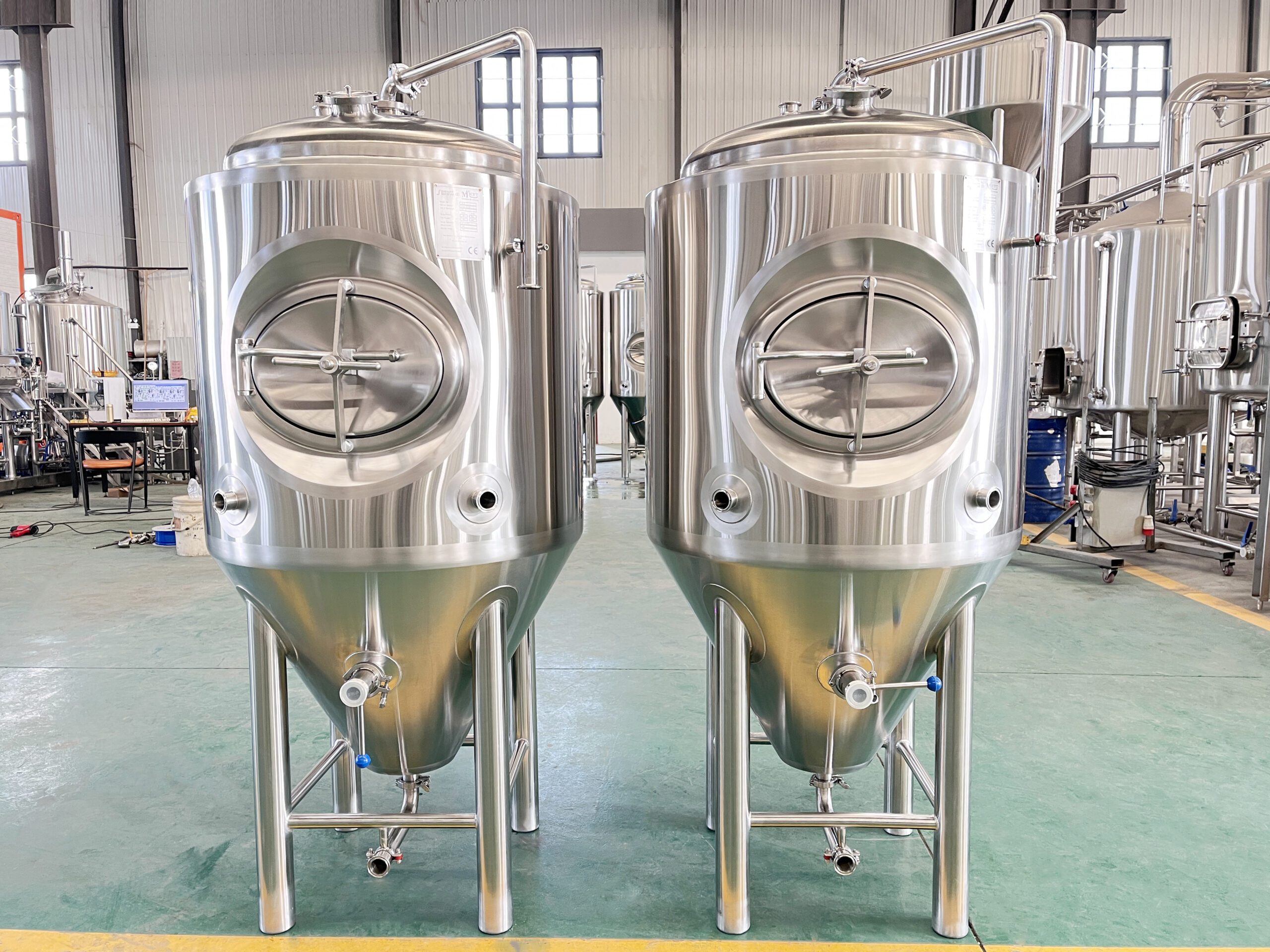
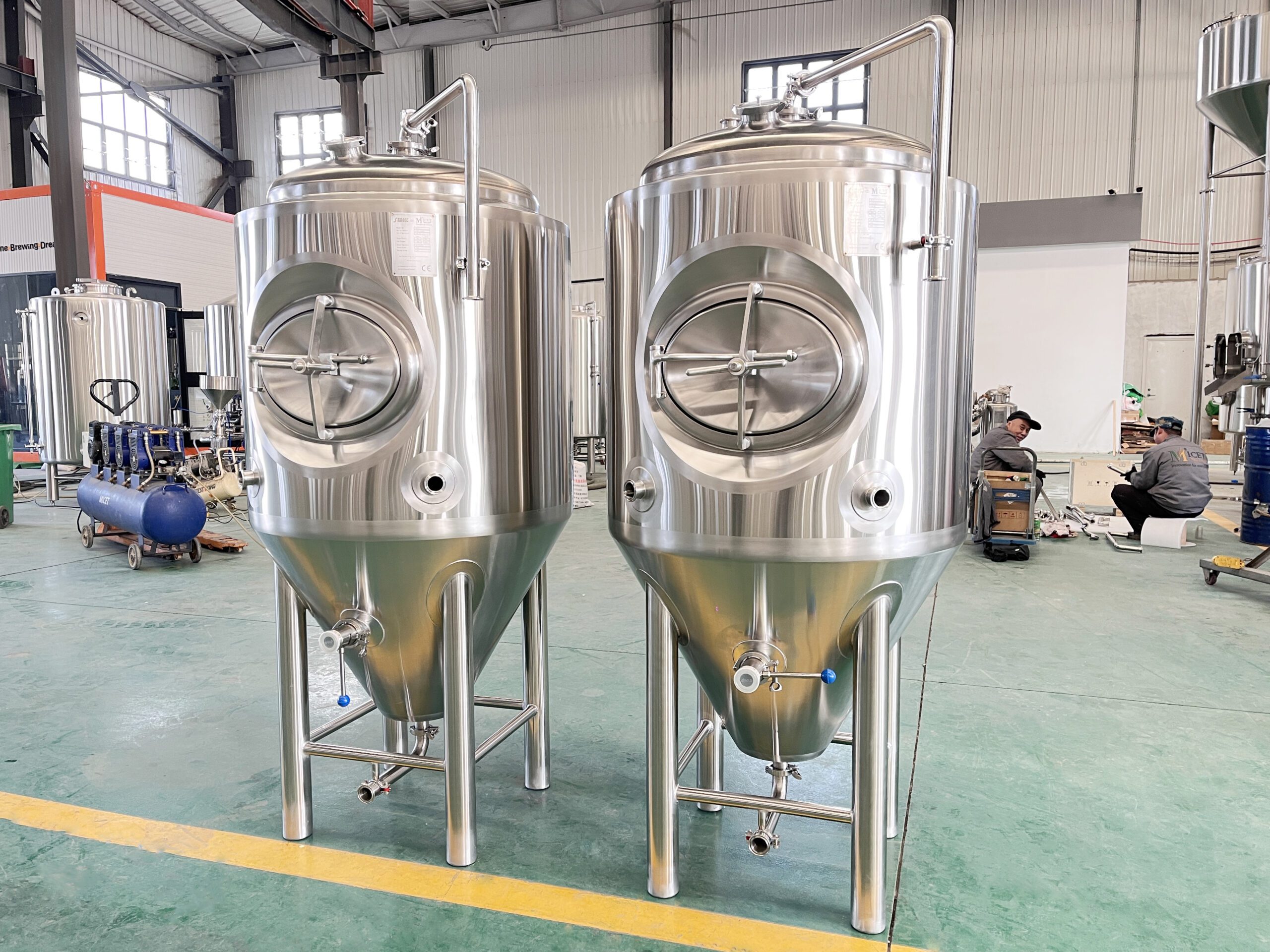
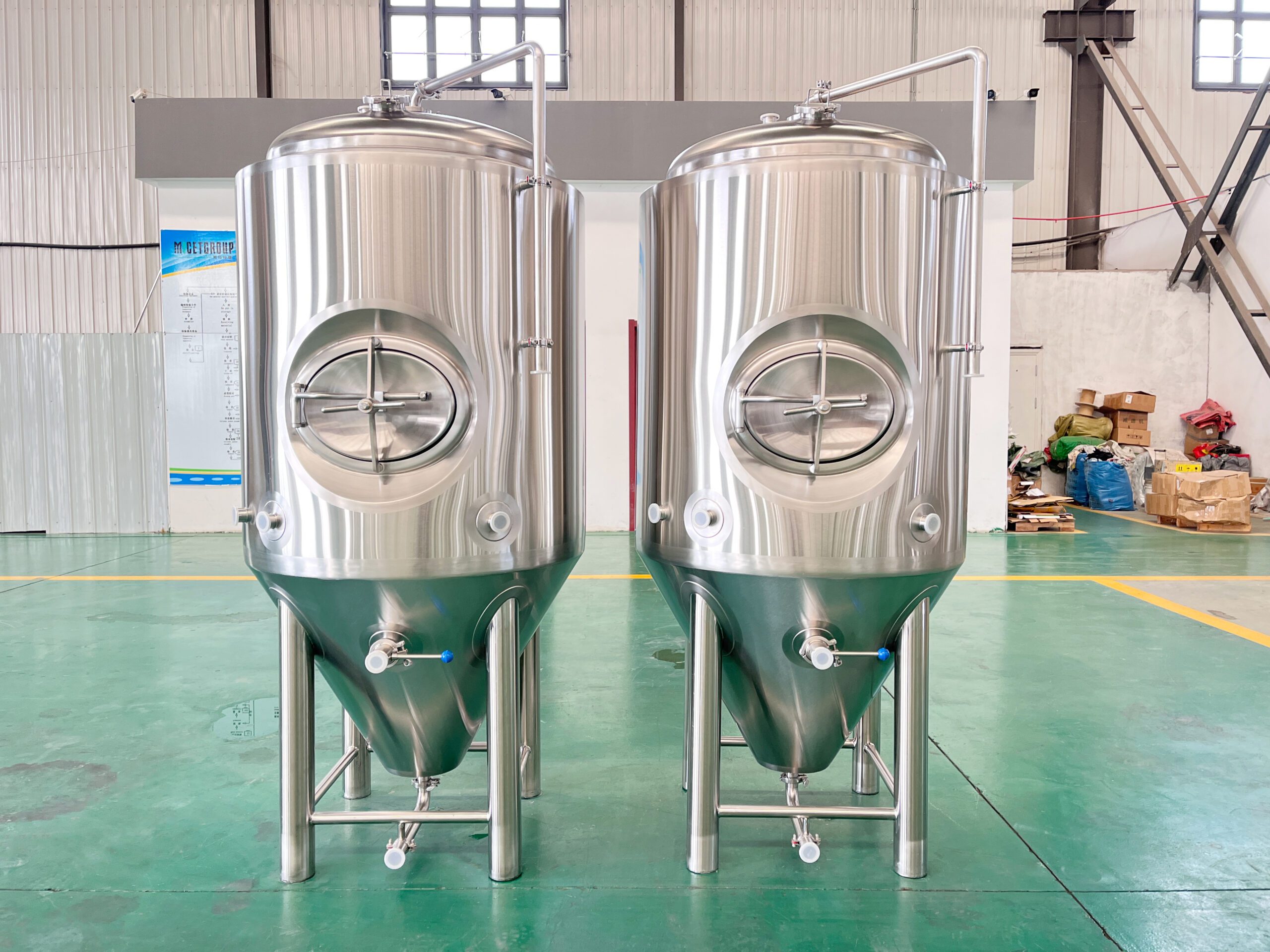
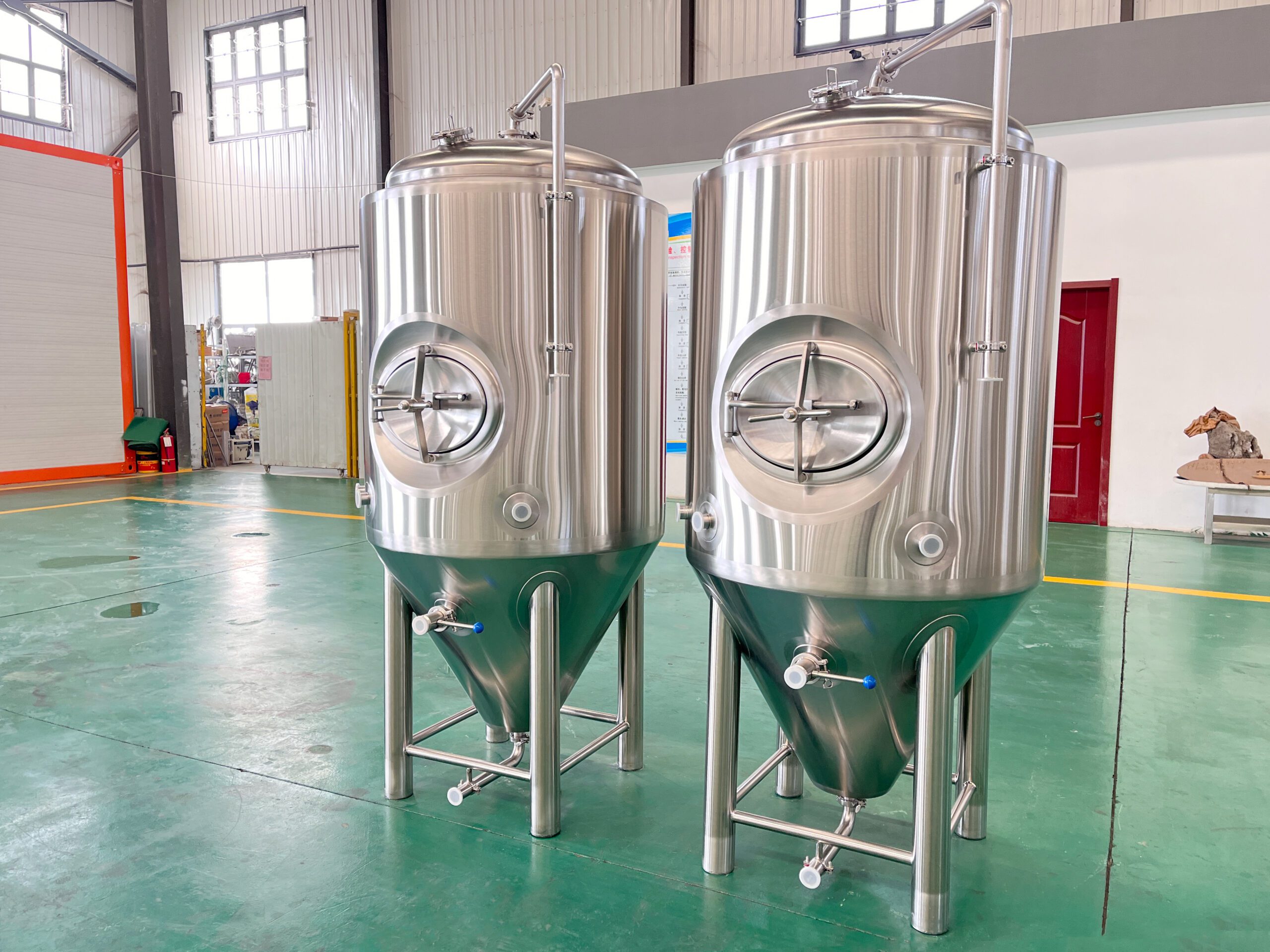
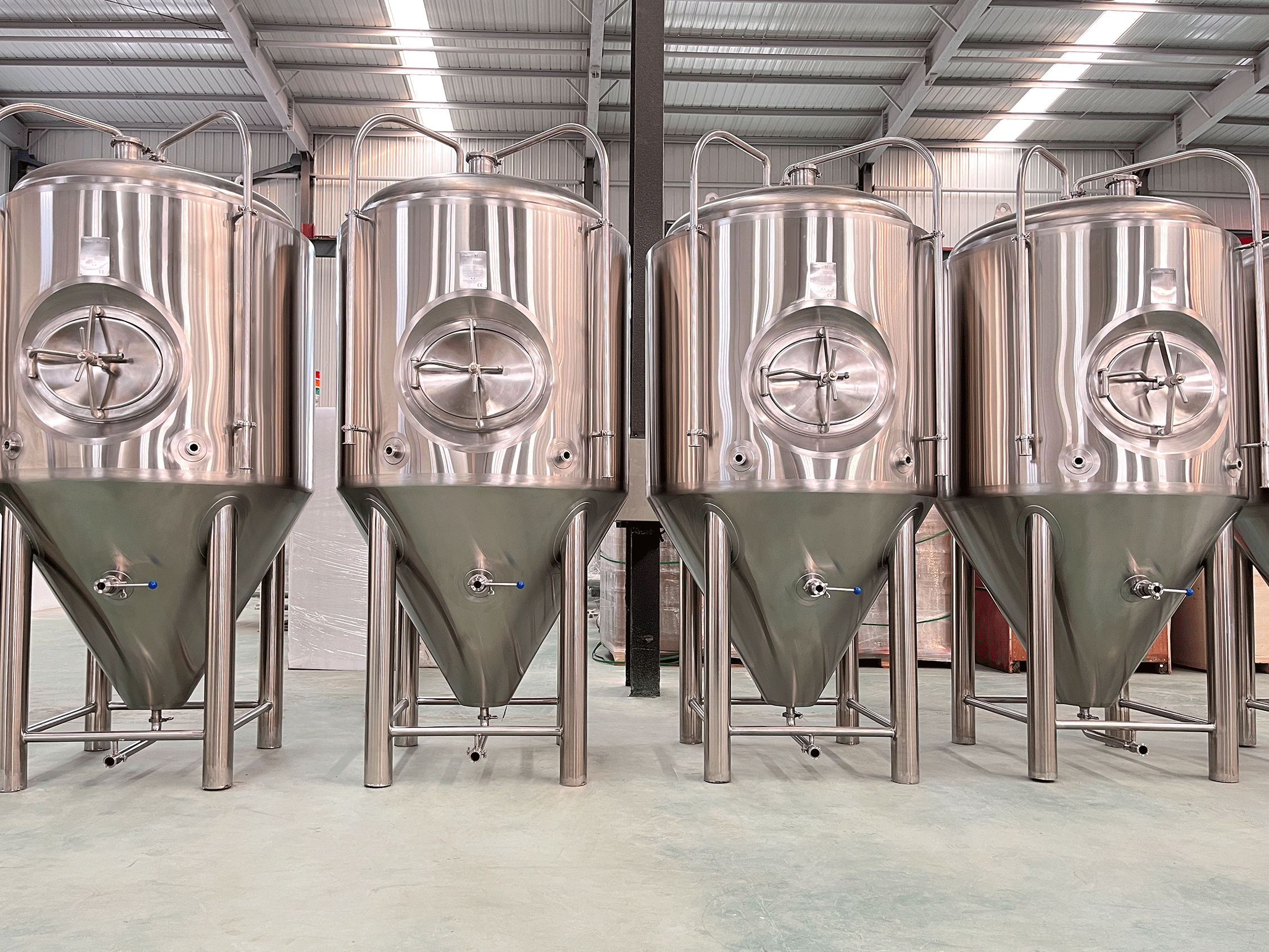
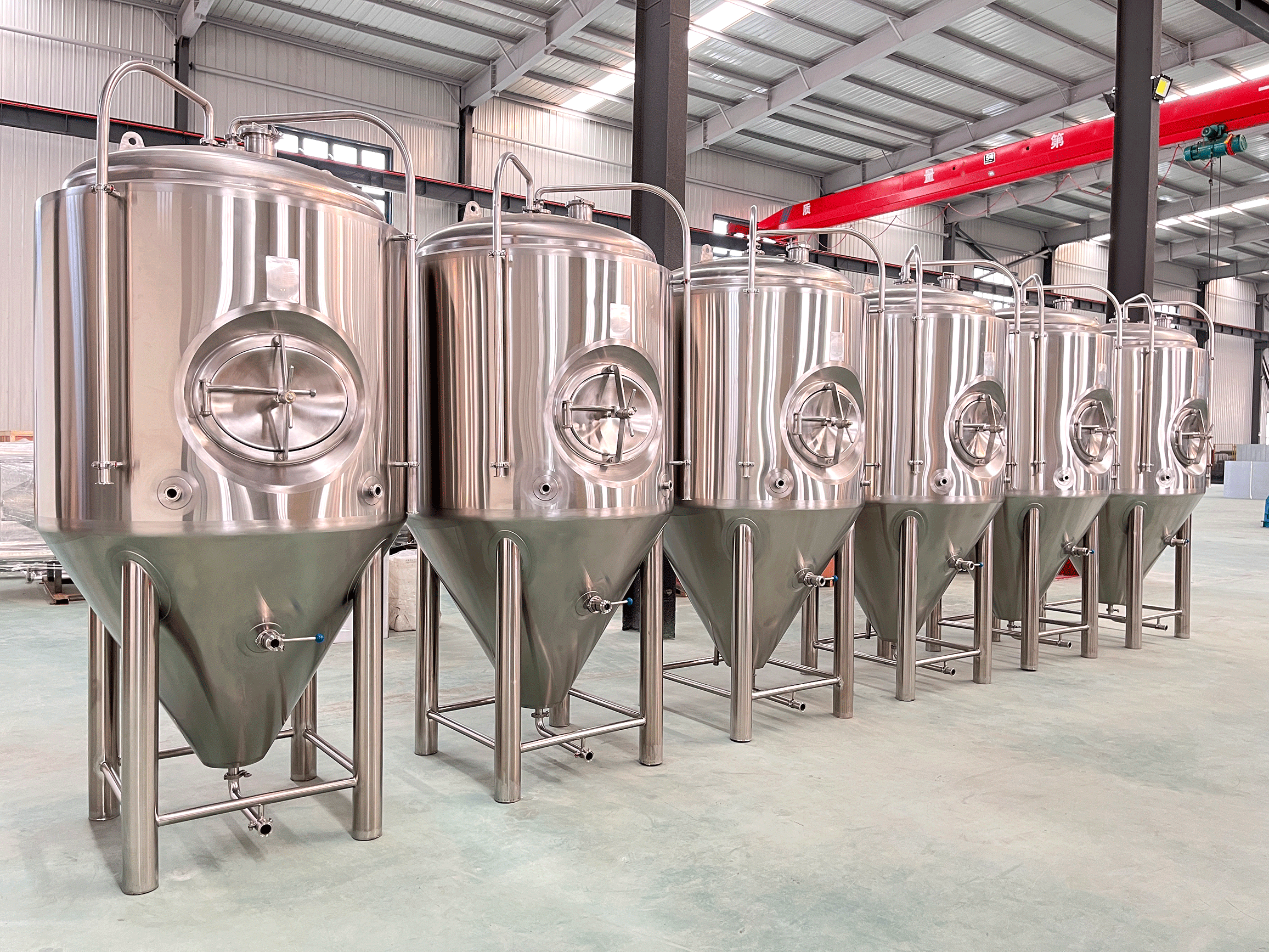
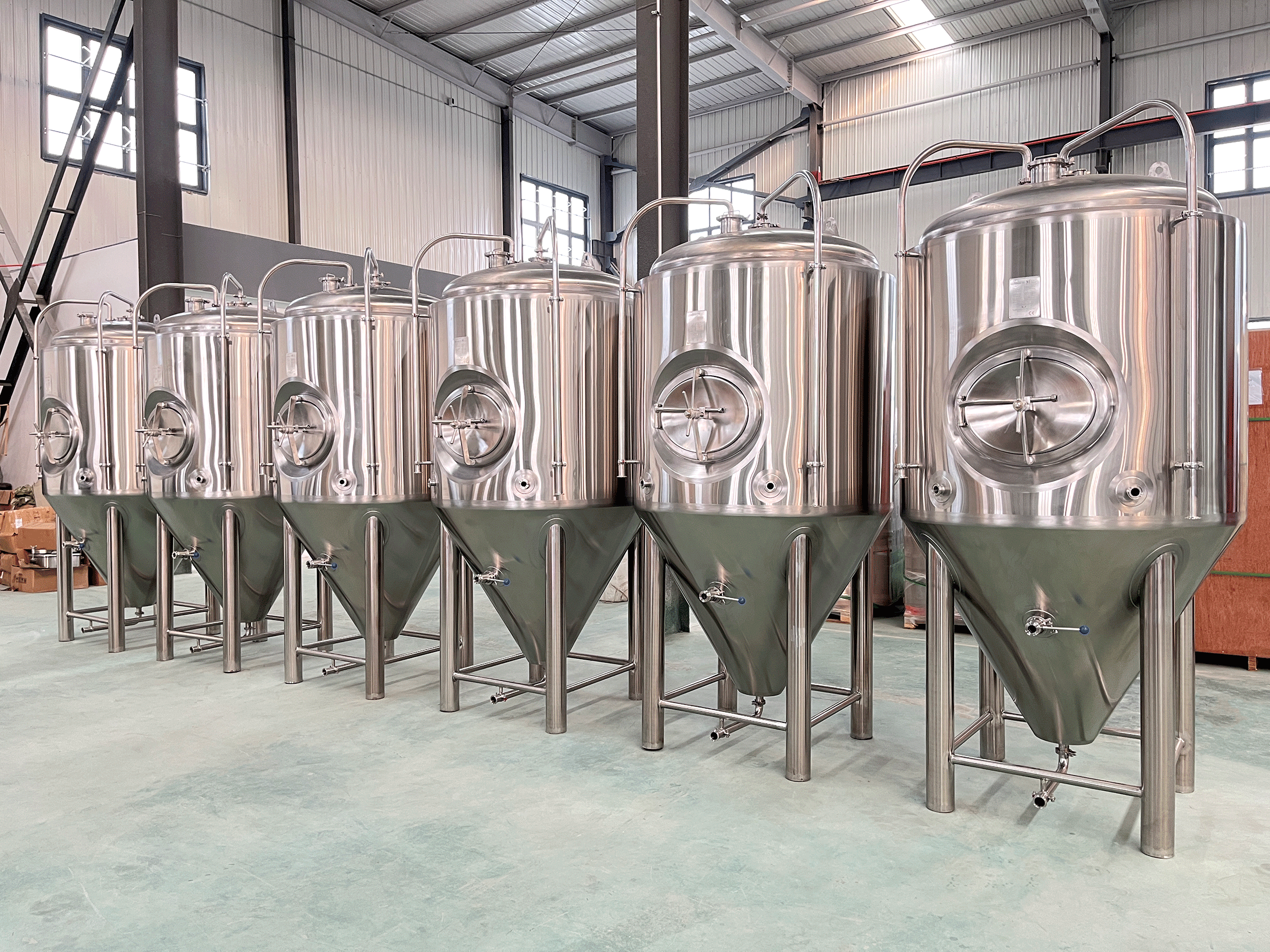
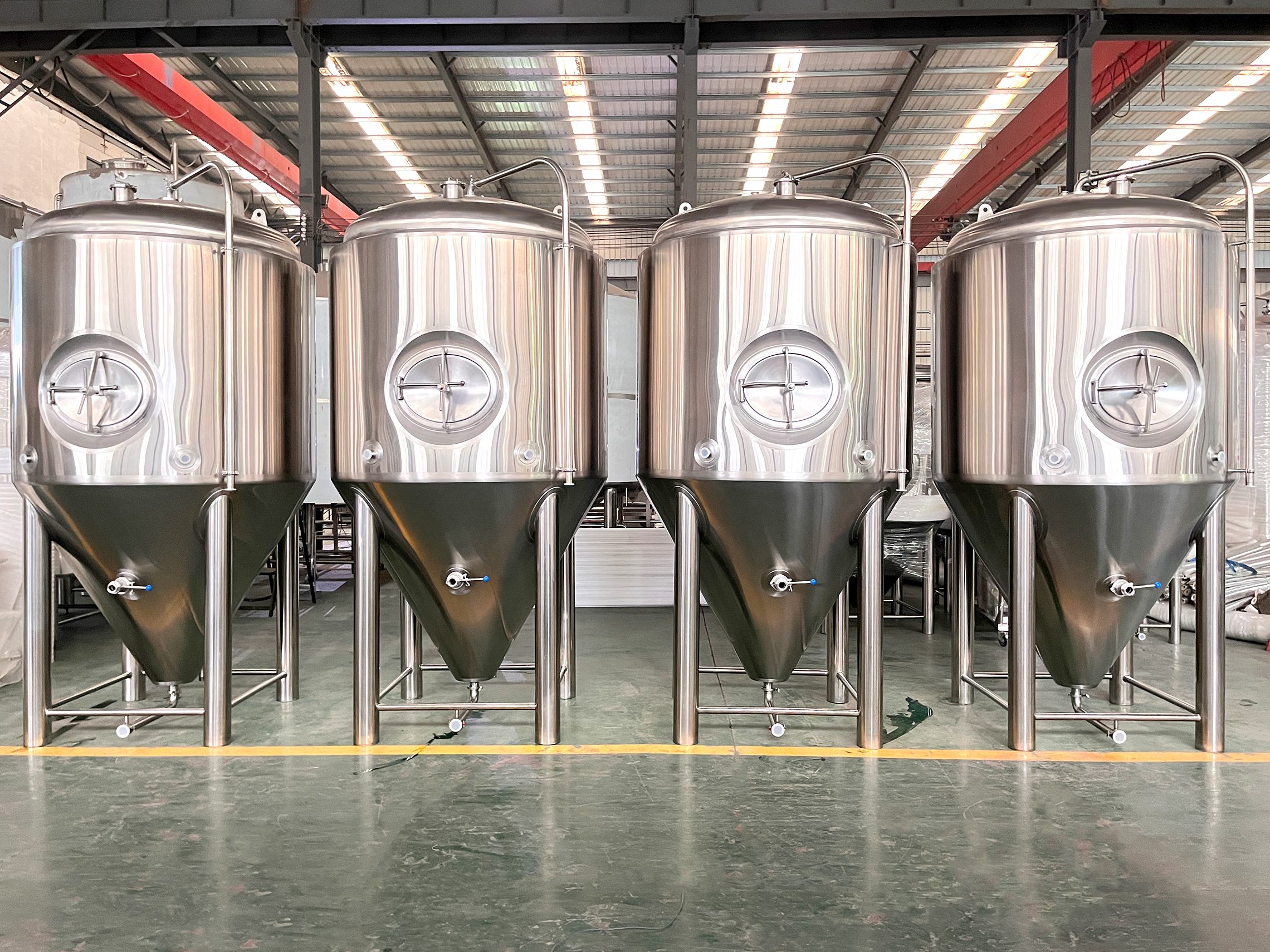
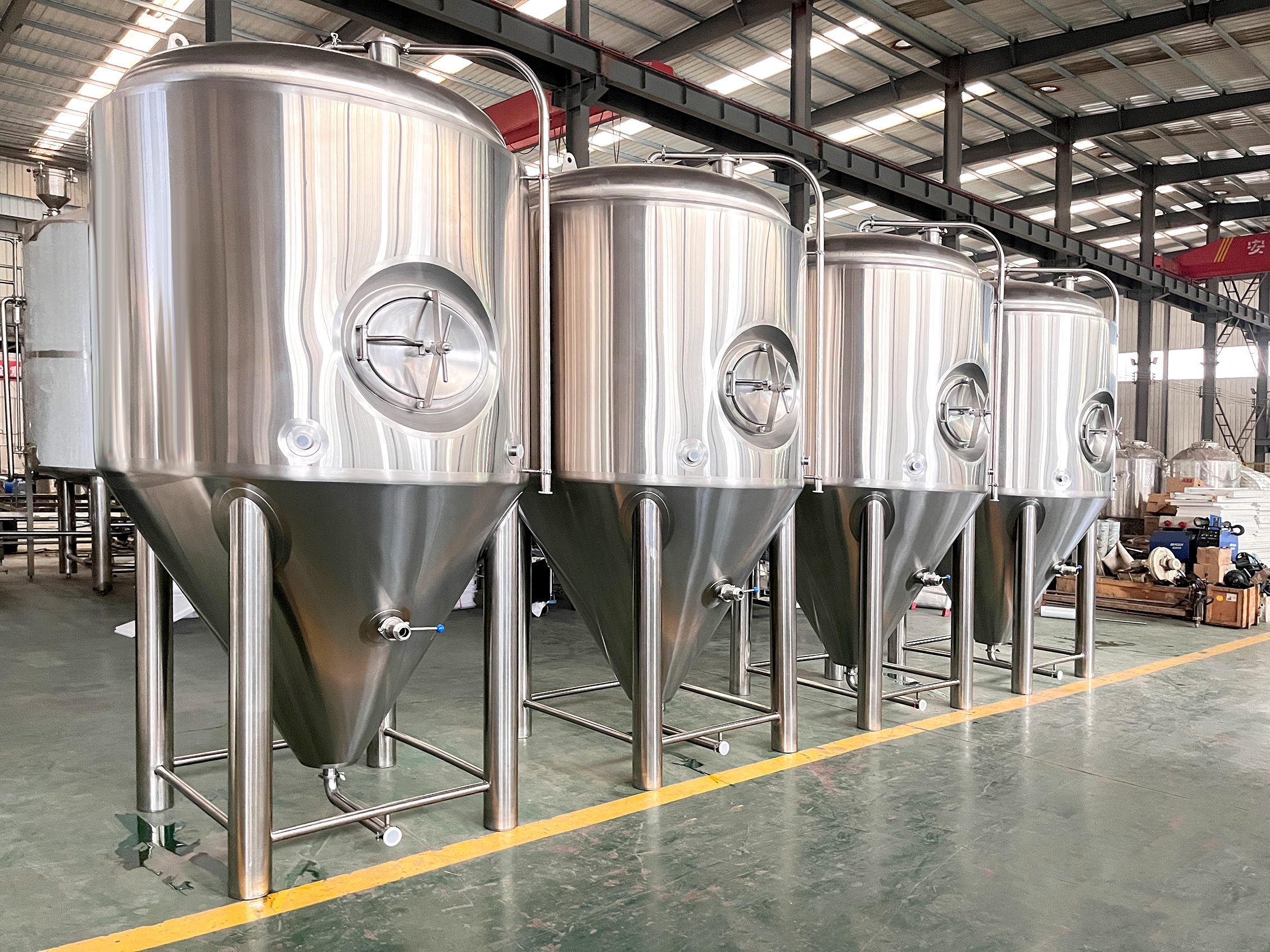
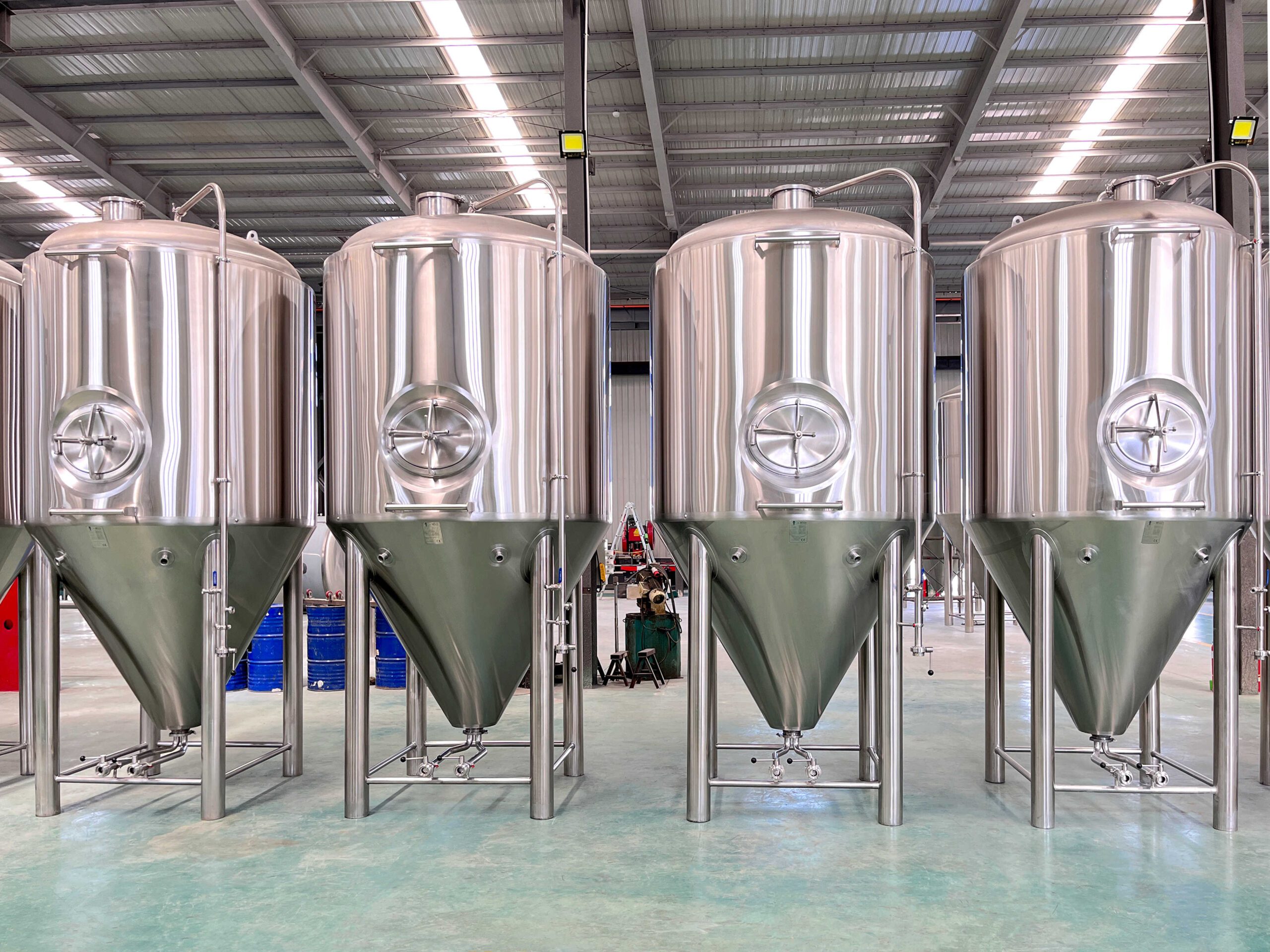
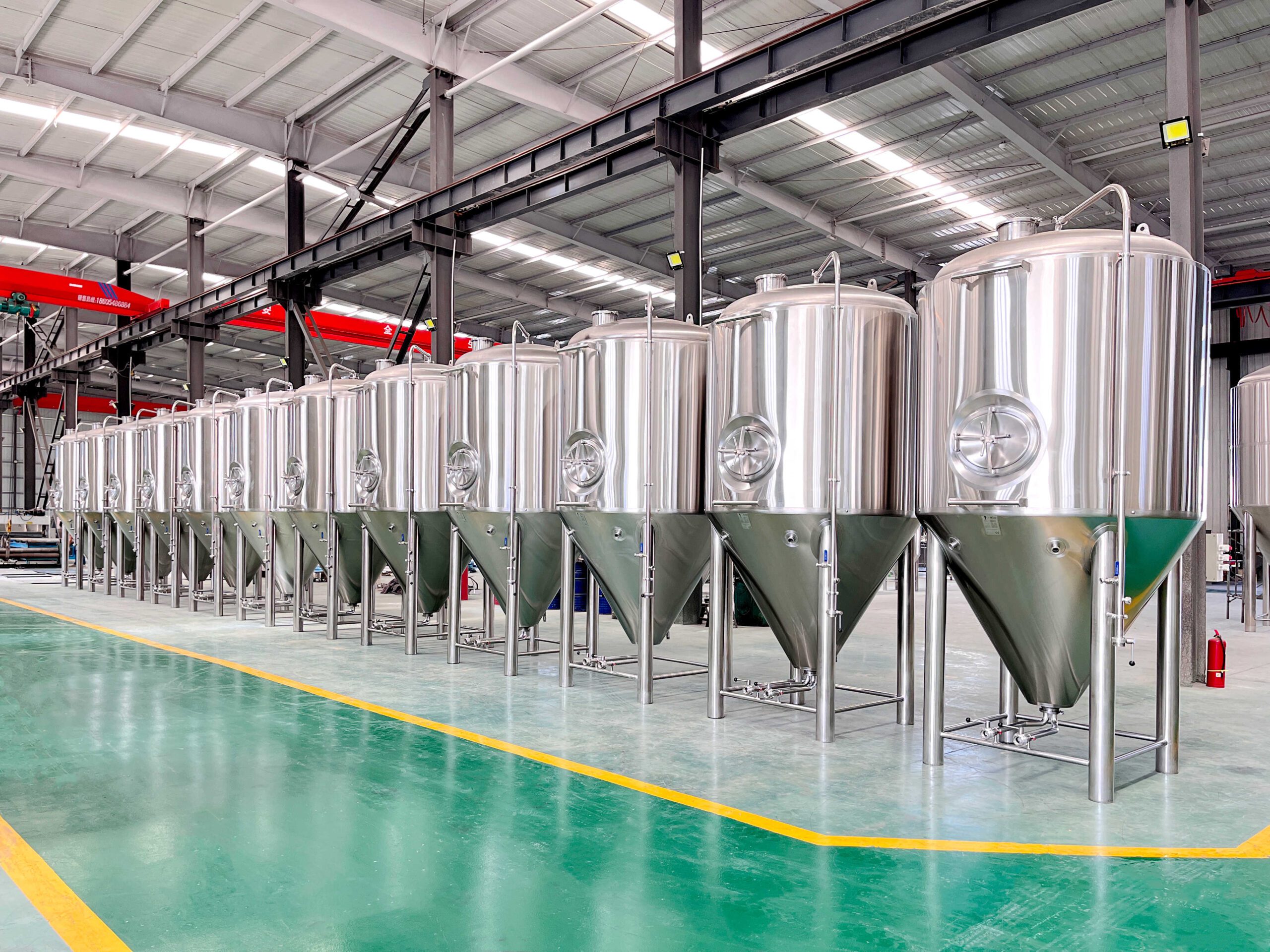
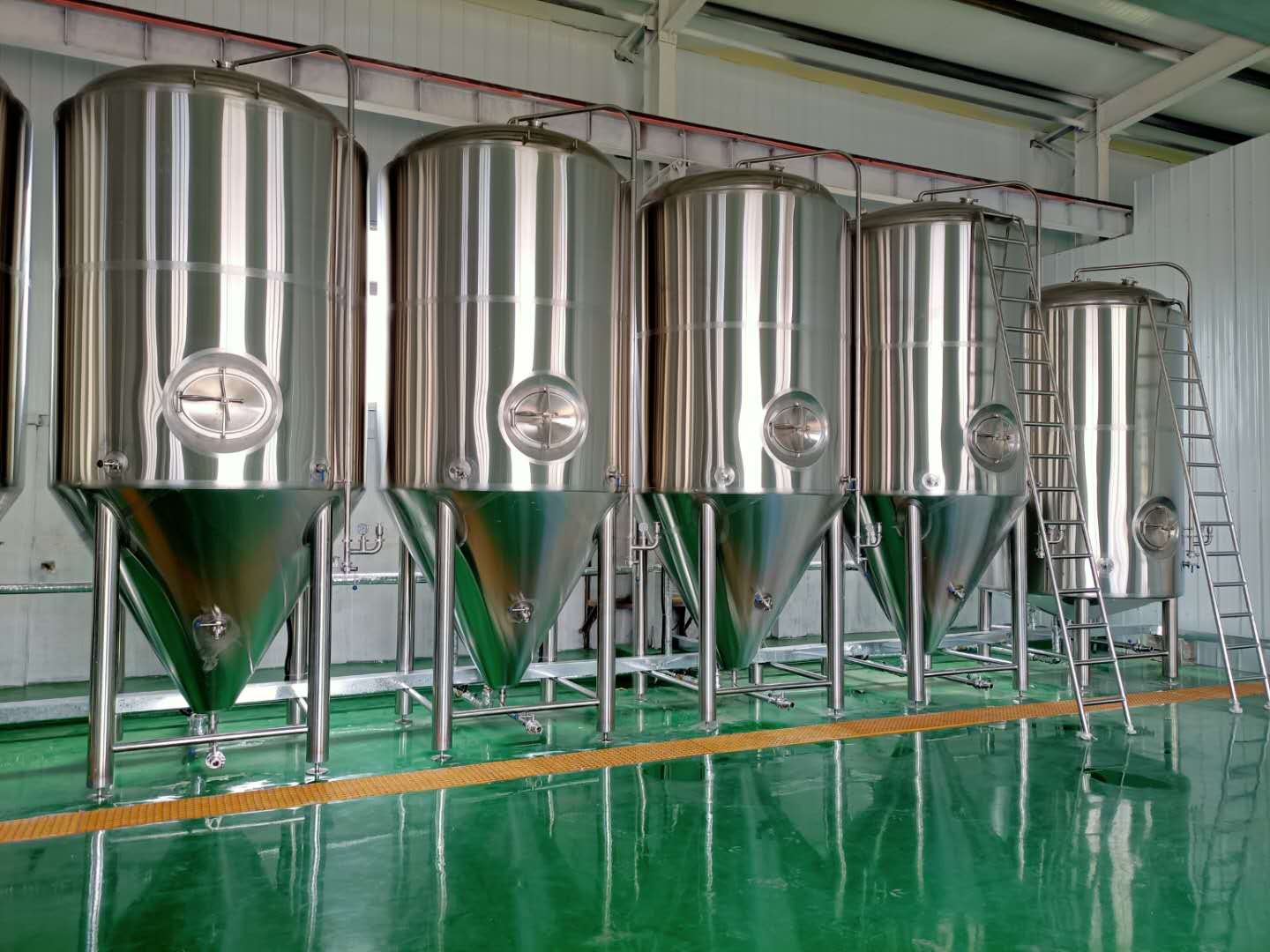
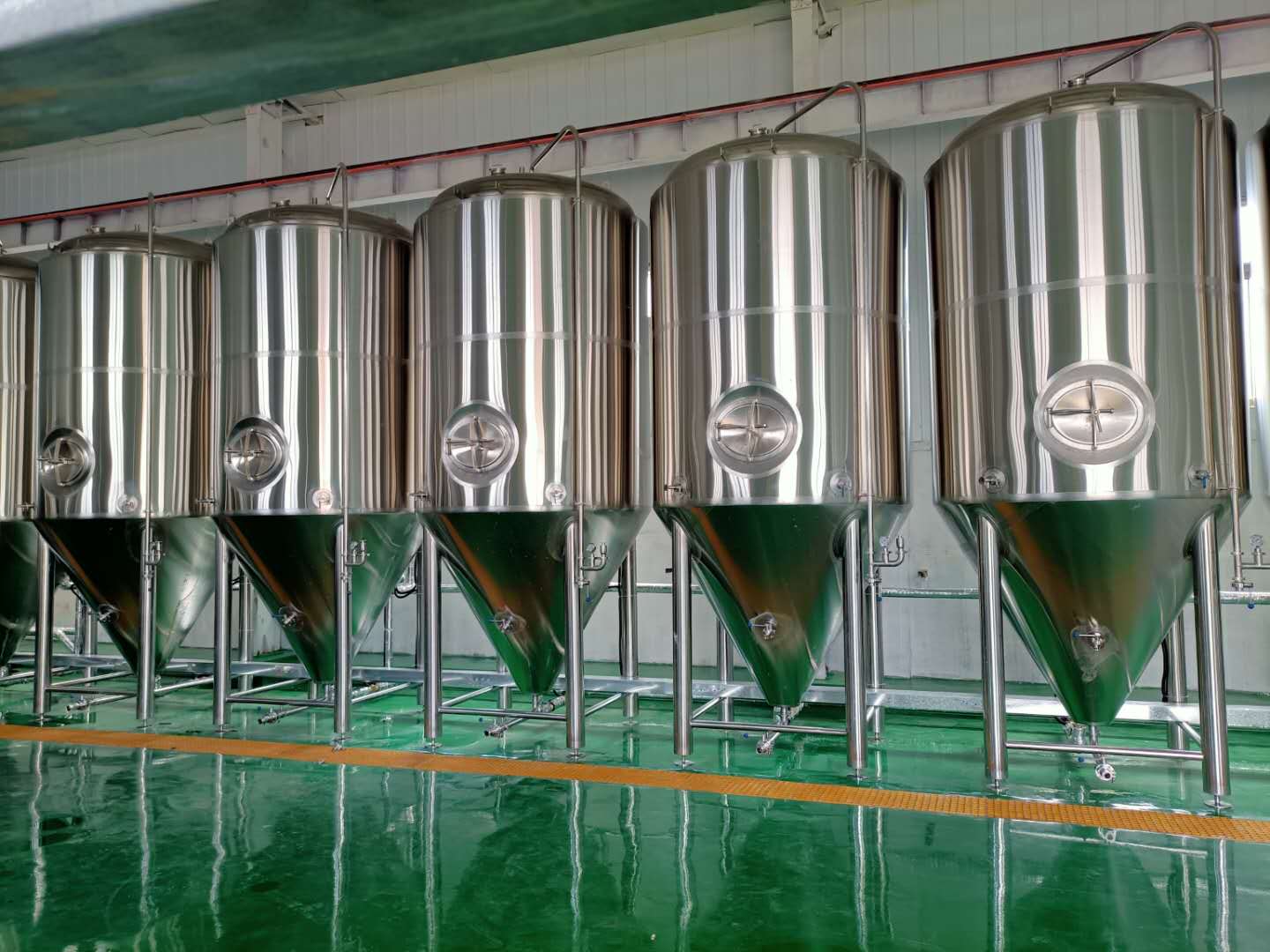
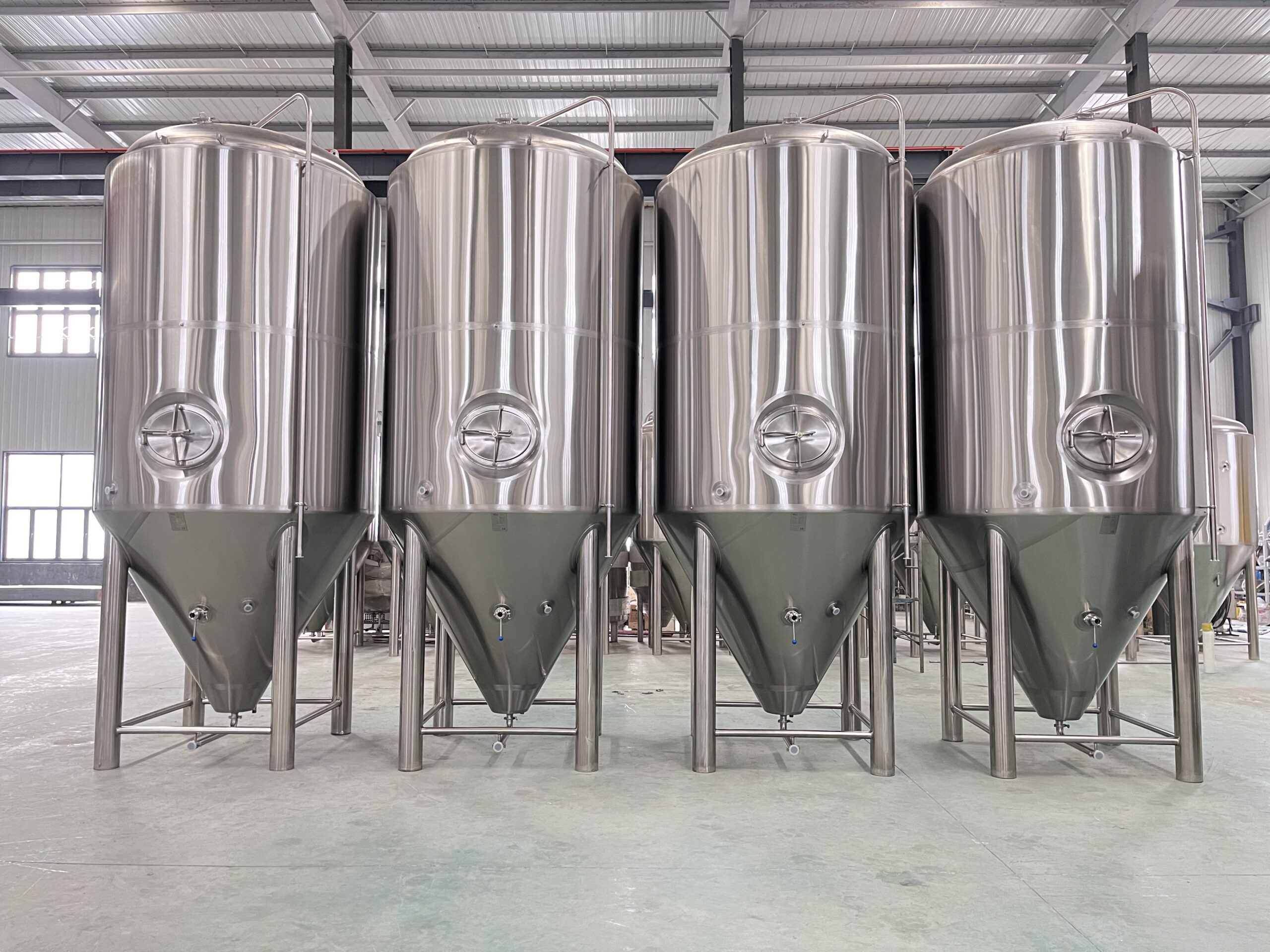
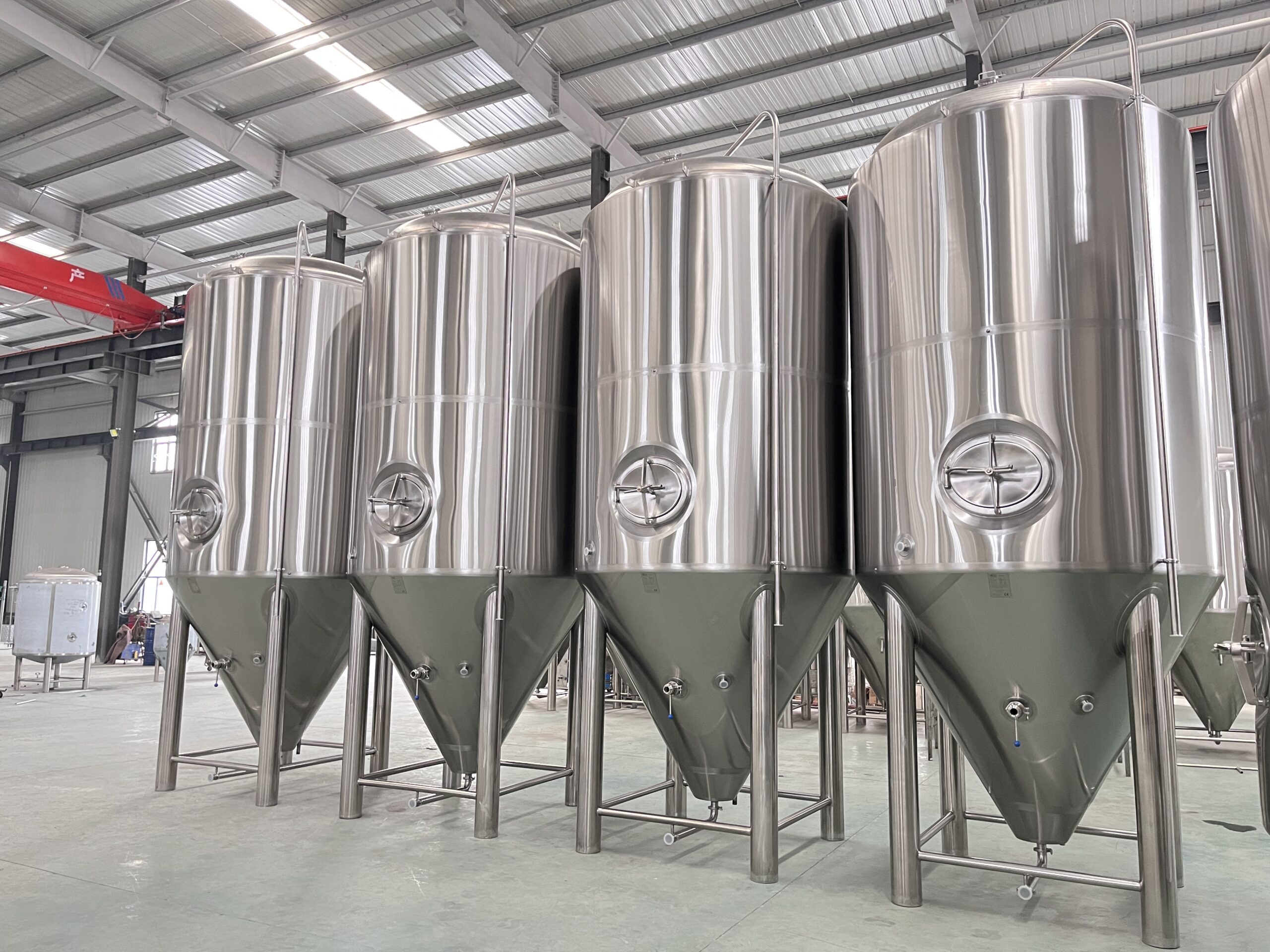
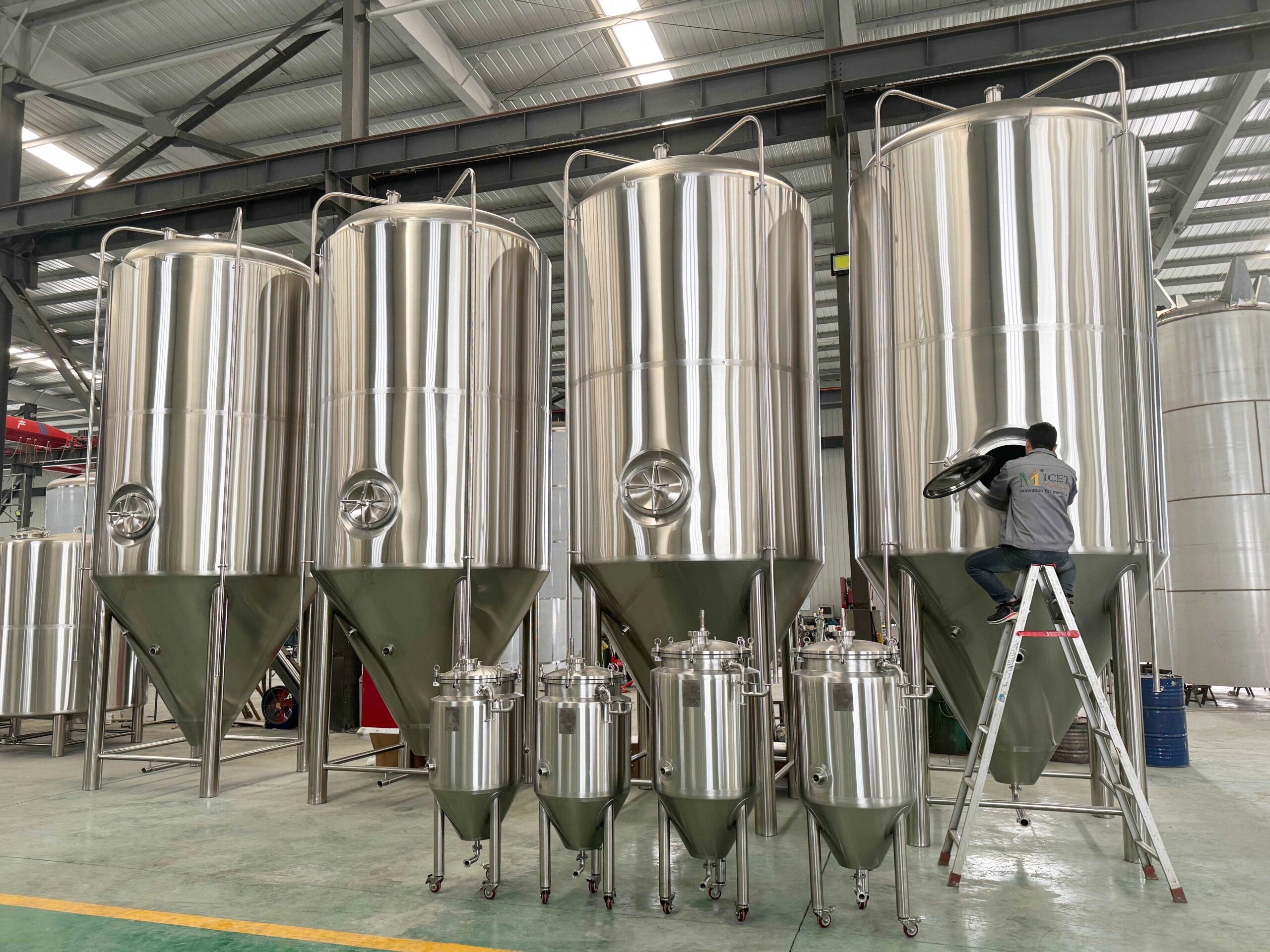
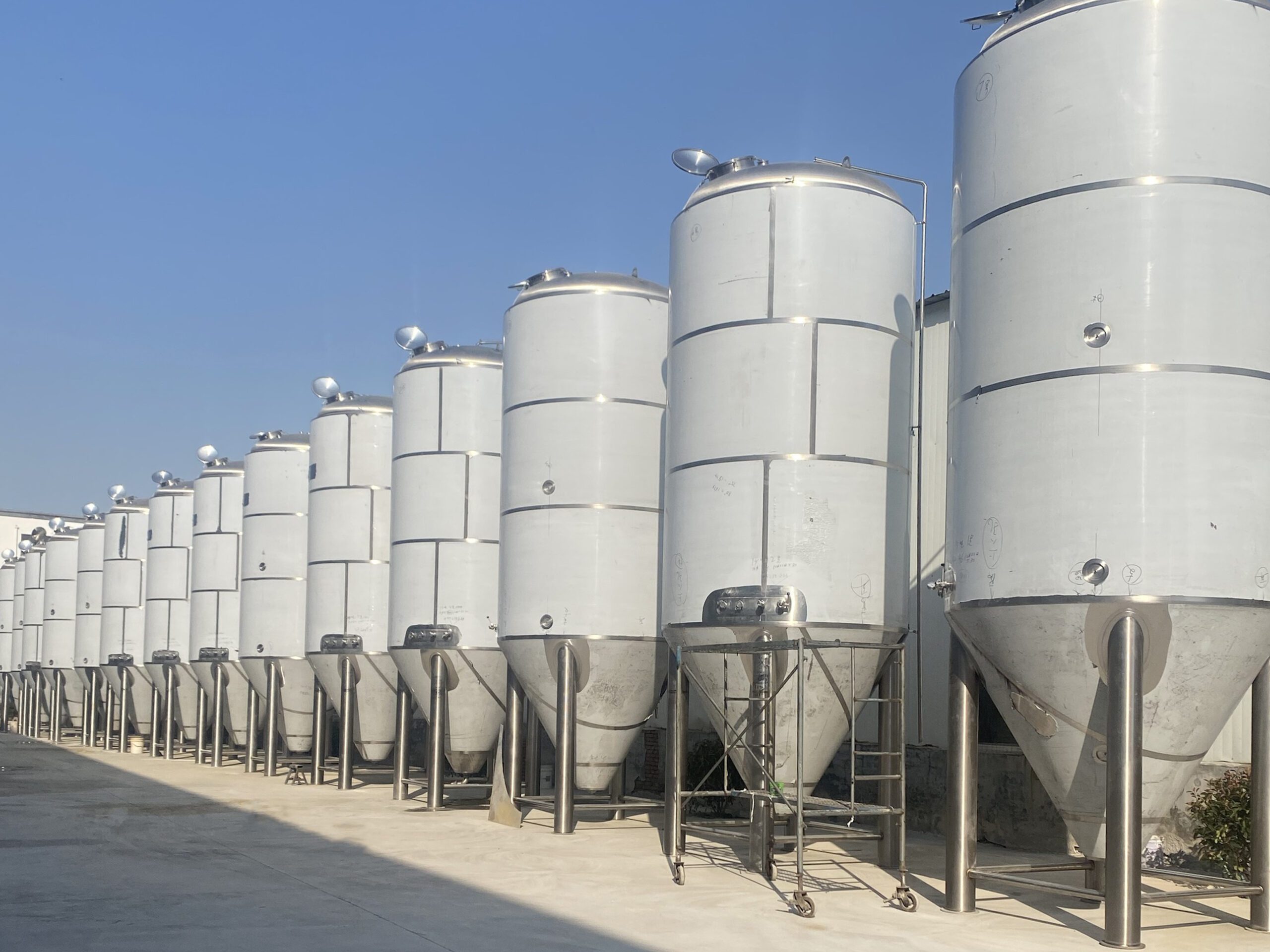
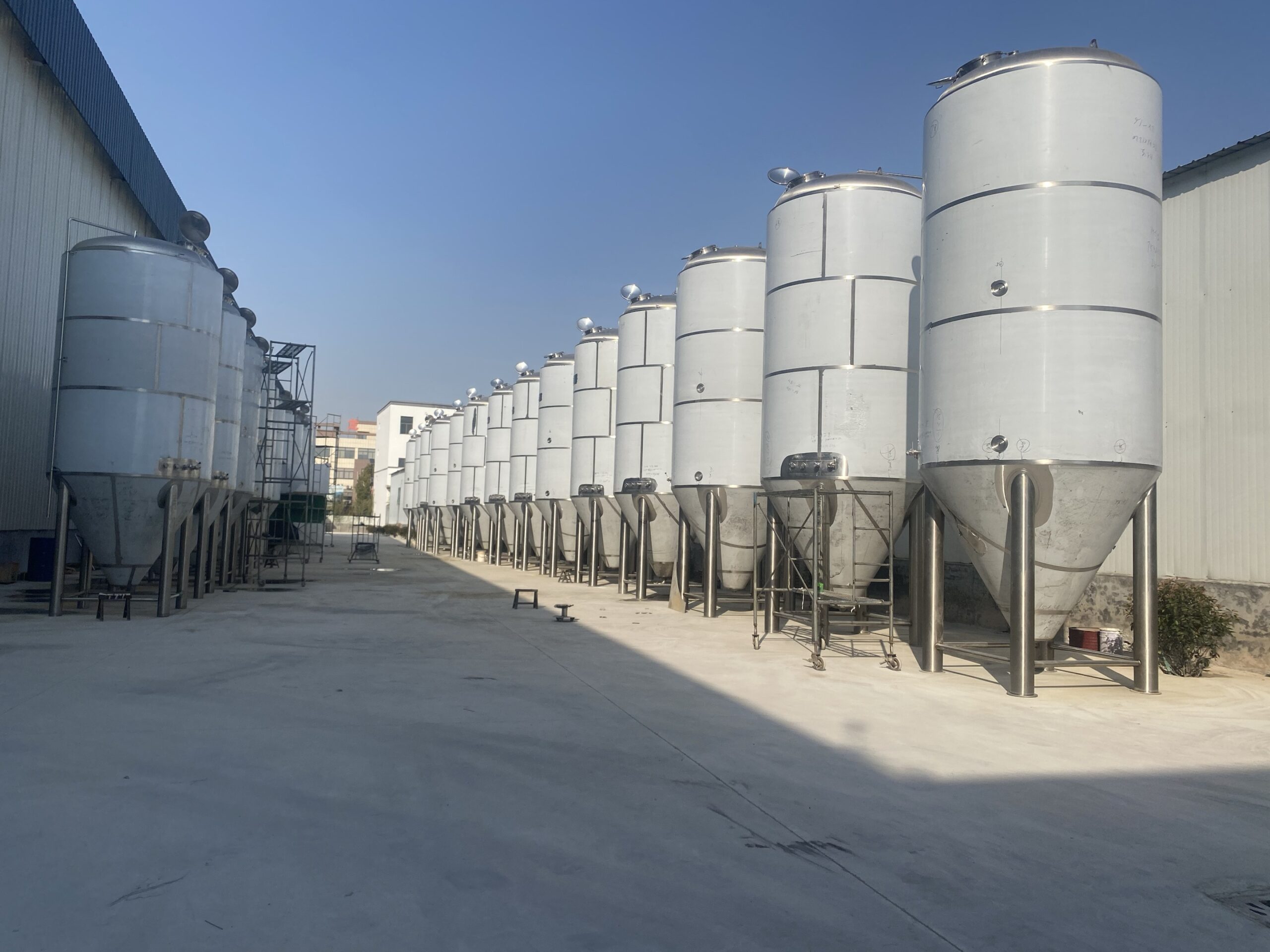
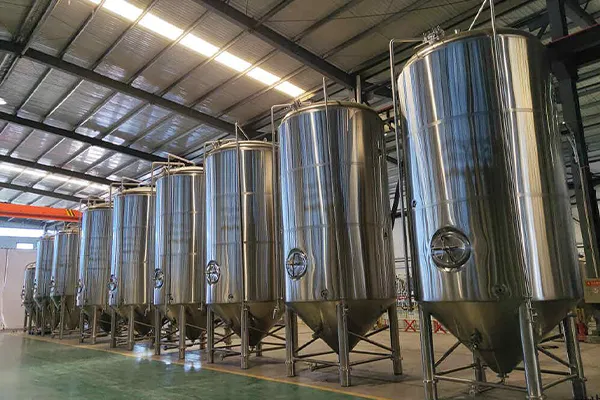
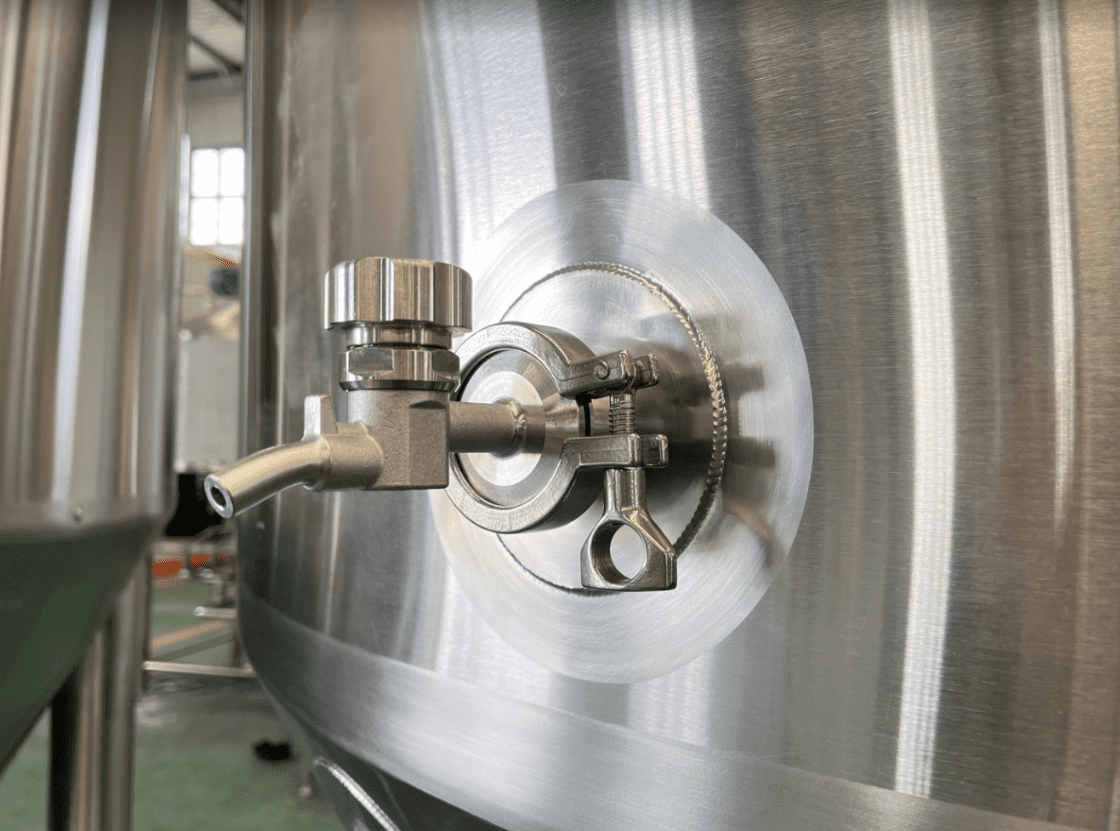
Our Fermentation Cellar Projects & On-Site Photos show used fermentation tanks installed in real breweries and beverage plants, so you can see actual layouts, tank rows and piping, and imagine how similar setups can work in your own project.
Cut costs with used fermentation tanks ready for beer, kombucha, cider, wine and beverage plants—capacity matched to your cellar plan.
Pressure-Rated Options – Verified condition for safe carbonation and serving.
Hygiene-Ready – Internal cleaning, passivation and inspection records available.
Fit-to-Layout Customization – Nozzles, outlets and connections adjusted if required.
Fast Export Delivery – Secure packing for overseas transport.
Choose from a wide range of capacities to match your brewhouse size, number of SKUs and production plan.
Compact 300L stainless steel fermentation tank for pilot brewing, test batches or small kombucha / cider lines, pressure-tested and internally cleaned before shipment.
500L used fermentation tank suitable for nano breweries and restaurant breweries, with stainless-steel construction and optional cooling jacket for controlled fermentation.
1000L pre-owned fermentation tank for microbreweries and kombucha producers, supplied with basic fittings and inspected welds, ideal for small commercial production.
2000L used fermentation tank for growing craft breweries, with jacketed cooling and cone or dish bottom options, pressure-tested and ready for integration into your cellar.
2500L second-hand fermentation tank designed for higher-output microbreweries, supporting multiple batches per week and stable temperature control with glycol jackets.
High-capacity 5000L used fermentation tank for regional breweries or central production sites, suitable for beer, cider or other beverages, with tested pressure rating and hygienic internal finish.
This used 10T fermentation tank package uses MICET’s standard fermentation tank design and combines large-volume used fermenters with refurbished bright beer tanks.
15T fermentation tank package using two 6500L conical fermenters and twelve 3000L fermenters. All tanks are SUS304,insulated, jacketed and refurbished
20T fermentation tank package using two 6500L conical fermenters and twelve 3000L fermenters. All tanks are SUS304,insulated, jacketed and refurbished
SS304 / SS316
Internal surface roughness (e.g. Ra ≤ 0.6–0.8 μm when available)
Internal pickling & passivation
SS304 / SS316
Internal surface roughness (e.g. Ra ≤ 0.6–0.8 μm when available)
Internal pickling & passivation
Manway, CIP spray ball, sampling valve, thermowell, level indicator, inlet/outlet sizes
Tri-clamp / DIN / SMS connections
Before any used brewery equipment is offered to you, it goes through a strict refurbishment and quality control process in our factory. This helps you avoid hidden risks, reduce installation issues and put the system back into production as quickly as possible
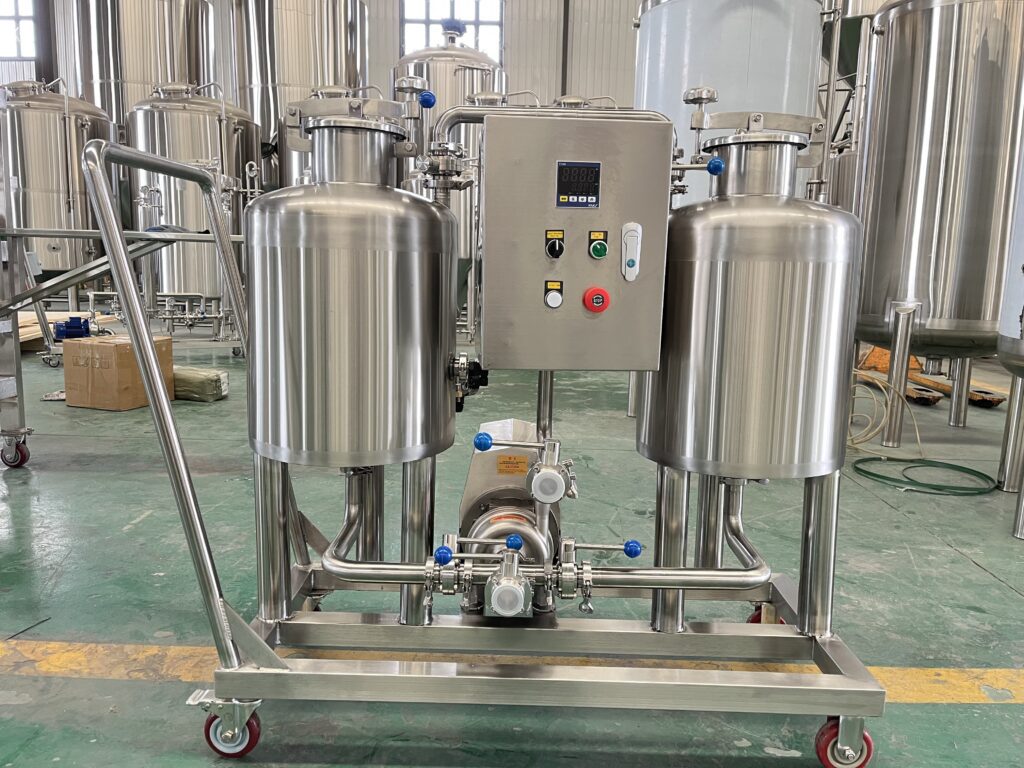
In many cases, the best solution is used fermentation tanks or unitanks combined with new glycol chillers, pump skids, manifolds and CIP systems. We refurbish the tank body, jackets and fittings, then engineer new cooling, valves and cleaning loops around them. This keeps your main cellar volume cost-effective, while hygiene, temperature control and maintenance are handled by reliable new equipment.
Tell us about your project and our engineers will design a hybrid new + used solution just for you.
We can modify used fermentation tanks to fit your existing cellar layout and process design.
PRV, sampling valves, carbonation stone, racking arm, level gauge, thermowell
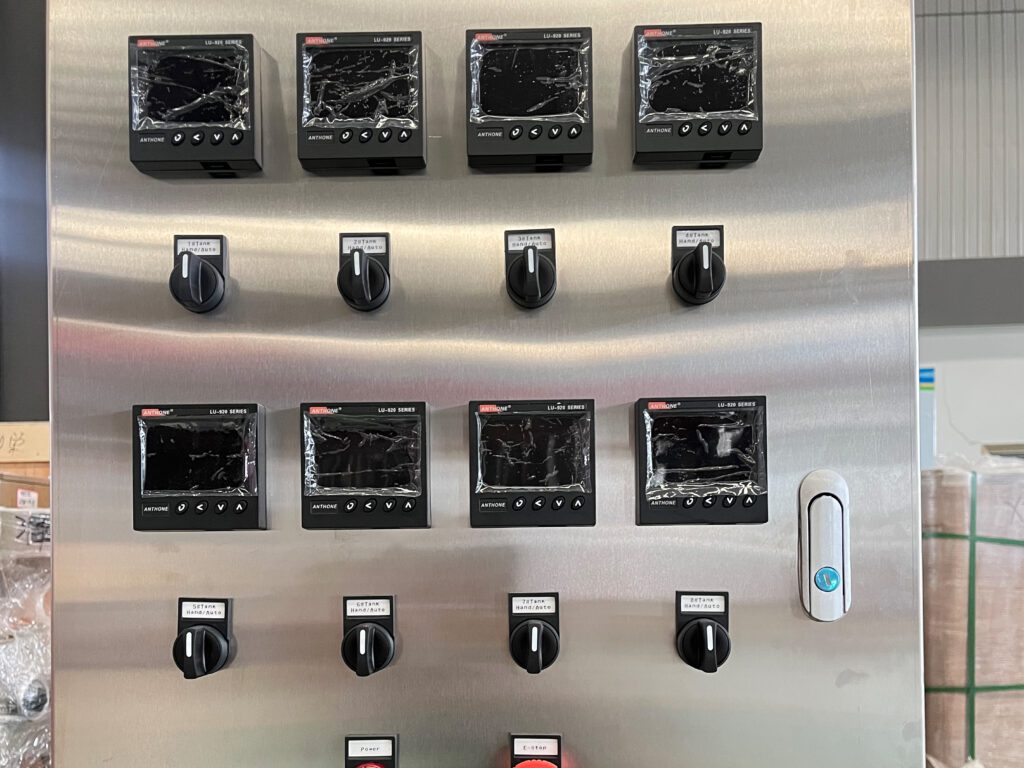
Temperature sensors, basic control panels, PLC integration options
CIP spray balls, CIP return connection, CIP set integration
Add/remove nozzles, change leg supports, adjust outlet height, add ladders or platforms
MICET has performed actual installations in more than 100 countries—customized brewery, kombucha, distillery, winery systems, fermentation tanks, and stainless steel tanks.
Explore how we design, manufacture, install, and support turnkey projects from nano to commercial scale.

Nancy Shang | Founder and CEO, MICET Brewing | Published August 6, 2026
Inspect a used fermentation tank in this order: pressure-hold the vessel and the glycol jacket separately, then check jacket coverage against the cone, then the manway seat, then racking arm wear. MICET’s published used tanks carry 0.2 MPa design pressure and 0.3 MPa test pressure, which gives you a reference figure to test against.

Most buyers inspect a used fermenter by walking around it and looking at everything at once. The problem with that approach is not effort. It is that the cheap findings and the expensive findings get discovered in the wrong order.
A split glycol jacket ends the conversation. A worn racking arm gasket costs less than the shipping crate. If you spend two hours documenting valve condition and surface finish before you pressure-test the jacket, you may have spent two hours on a tank you were never going to buy.
So the sequence below runs deal-breakers first. Each step tells you whether to continue or stop.
Before inspecting anything, you need a reference. Here is what MICET publishes for its used fermentation tank line, laid out by format.
| Dimension | 3–5 BBL | 10 BBL | 20 BBL | 40 BBL |
| Total capacity | 3–5 BBL | 10 BBL | 20 BBL | 40 BBL |
| Working capacity | Not published | Not published | Not published | Not published |
| Shell material | SUS304 | SUS304 | SUS304 | SUS304 |
| Cooling | Glycol jacket | Glycol jacket | Glycol jacket | Glycol jacket |
| Insulation | Polyurethane | Polyurethane | Polyurethane | Polyurethane |
| Design pressure | 0.2 MPa | 0.2 MPa | 0.2 MPa | 0.2 MPa |
| Test pressure | 0.3 MPa | 0.3 MPa | 0.3 MPa | 0.3 MPa |
| Certification | Not disclosed | Not disclosed | Not disclosed | Not disclosed |
| Dimension | 2T | 4T | 6T |
| Total capacity | 2,000 L | 4,000 L | 6,000 L |
| Working capacity | 1,800 L | 3,600 L | 5,400 L |
| Headspace allowance | 200 L (10%) | 400 L (10%) | 600 L (10%) |
| Shell material | SUS304 | SUS304 | SUS304 |
| Cooling | Glycol jacket | Glycol jacket | Glycol jacket |
| Insulation | Polyurethane | Polyurethane | Polyurethane |
| Design pressure | 0.2 MPa | 0.2 MPa | 0.2 MPa |
| Test pressure | 0.3 MPa | 0.3 MPa | 0.3 MPa |
| Certification | Not disclosed | Not disclosed | Not disclosed |
Two things to take from these tables.
First, the metric formats publish both total and working capacity, and the gap is consistent at 10%. The imperial formats publish a single capacity figure. When a listing anywhere in this market quotes you “20 BBL,” establish which number that is before you plan a batch schedule around it. A 20 BBL nameplate with 18 BBL of usable volume changes your yield math on every brew.
Second, notice the certification row. I will come back to it, because it is the field most sellers in this market handle worst, including in our own published catalog.

Work through these in order. Stop where a step fails.
Step 1. Pressure-hold the vessel.
Isolate the tank, bring it up on air or water to the seller’s stated test pressure, and hold. The published test pressure for this class is 0.3 MPa. Watch the gauge for at least 30 minutes and record the reading at 0, 15, and 30 minutes. Any decay you cannot trace to a fitting is a finding. A tank that will not hold pressure cannot carbonate, and a fermenter you cannot carbonate in is a bright tank you overpaid for.
Step 2. Pressure-hold the glycol jacket separately. This is the step that saves deals from going wrong, and it is separate from step 1 for a reason. A jacket that froze and split will hold its shape perfectly. It will look identical to a sound jacket from the outside, and the polyurethane insulation and outer shell hide the damage completely. Isolate the jacket circuit, pressurize on water, hold for 30 minutes, log the decay. If the seller will not permit this test, treat the refusal as the test result.
Step 3. Map jacket coverage against the cone.
Get the jacket layout, either as a drawing or by feeling the temperature differential with the glycol running. You are checking whether the jacket wraps the cone or stops at the cylinder. Cylinder-only coverage is common on cheaper builds and it will cost you every time you cold-crash: the yeast bed in the cone stays warm while the beer above it drops, and your diacetyl rest never fully ends. Also confirm the jacket zone count. A single-zone 40 BBL tank behaves very differently from a two-zone tank of the same volume.
Step 4. Inspect the manway seat with a light held at an angle.
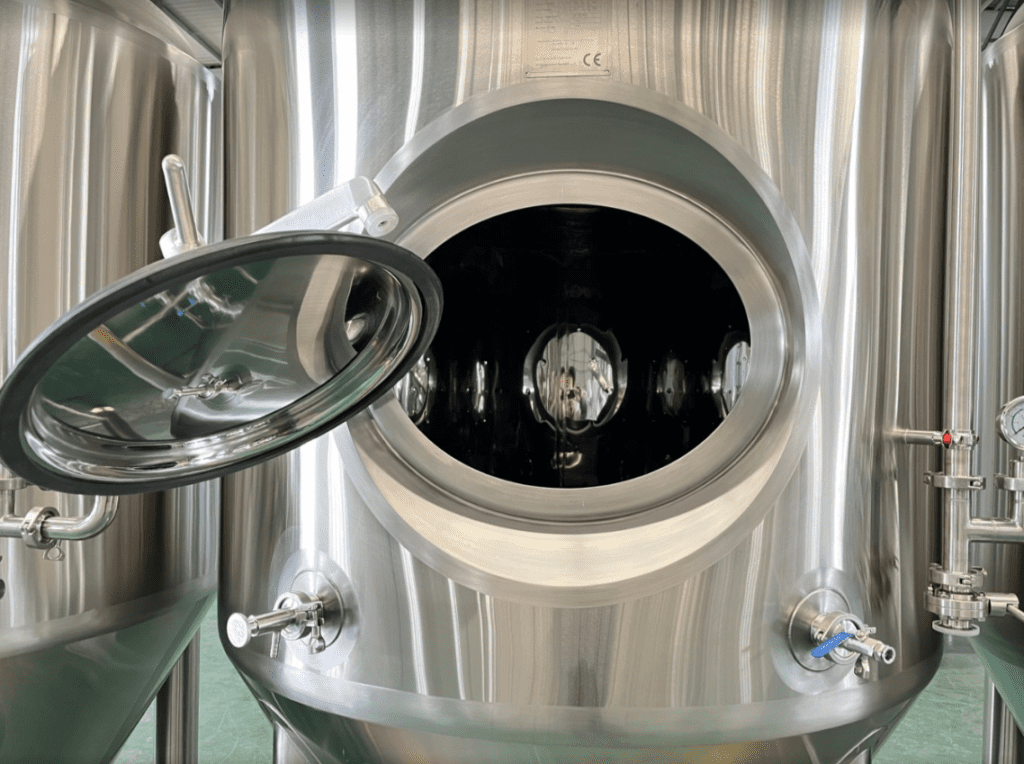
The gasket groove is where crevice corrosion starts, because it holds moisture and caustic after every CIP. Run a fingernail along the seat. Any catch or pitting you can feel is a leak path that will get worse. Then close the manway and check that the dogs or clamps pull the gasket down evenly. Uneven closure means the frame has been distorted, usually by overtightening, and straightening a manway frame is not a field repair.
Step 5. Pull the racking arm and check the wear points.
Rotate it through its full travel first, feeling for grinding or slop in the rotation. Then remove it. You are looking at three things: the seal or packing at the shell penetration, the arm tube itself for pitting on the interior, and whether the arm still seats at a repeatable angle. An arm with rotational play will not park where you set it, which means you cannot reliably rack above the trub line. Replacement seals are inexpensive. A worn shell penetration is a welding job.
Step 6. Scope the interior weld seams and the cone bottom.
Light at an angle, bore scope if you cannot get inside. Focus on the cone-to-cylinder weld and the dump valve penetration, which sit at the bottom of every CIP cycle and see the highest concentration of settled solids and caustic. Photograph anything you find with a scale reference in frame. Polished-flat weld sections usually indicate a prior repair, which is worth asking about rather than assuming the worst.
Step 7. Verify shell grade against a document.
Ask for the mill certificate. EN 10204:2004 is the standard governing material inspection documents, and it appears among the standards named in MICET’s ICR verification of conformity, certificate ICR/VC/HM2507146, issued by ICR Co., Ltd. The published shell grade for this line is SUS304. If the seller cannot produce a material certificate, you are buying grade on assertion.
Step 8. Check every fitting, port, and thermowell you will actually use.
Count them and compare against your process: sample valve, thermowell, CIP port, carbonation stone port, pressure relief, blowoff. Missing ports can be added, but adding a port to a jacketed and insulated tank means cutting through the outer shell and insulation, then re-sealing. Price that before you treat it as a minor modification.
Step 9. Measure the tank against the room, including the legs.
Overall height with legs, plus clearance above for the top manway or CIP arm and room to remove it. Then your door, your lowest ceiling obstruction, and your floor drain position relative to the dump valve.
Buyers evaluate used fermenters on interior surface condition, because that is what photographs well and what feels like the sanitary risk. Interior finish matters, but it is also the most repairable thing on the tank. Repassivation and polishing are routine work with known costs.
The jacket is the opposite: hidden behind insulation, expensive to access, and effectively unrepairable in place on many builds. Cutting the outer shell, removing polyurethane insulation, repairing the jacket weld, re-insulating, and re-cladding often approaches the cost of a comparable replacement tank. That is why steps 2 and 3 come before step 6 in the sequence above.
If you are buying an unjacketed tank, or a tank intended for open or atmospheric service such as a cold liquor vessel or a non-pressurized cider fermenter, steps 1 through 3 lose most of their weight and the manway, weld, and fitting checks become the whole evaluation.
There is a second case worth naming, because I see people apply the wrong caution here. Buying one tank to add capacity to a cellar you already run is a much smaller problem than buying a system. You have an existing glycol loop, an existing control system, and a working CIP setup. The tank has to hold pressure, cool evenly, and clean properly. That is genuinely the whole list, and a single-vessel purchase from a closure sale can be a sound buy where a full system purchase from the same source would not be.

MICET’s used fermentation tank line does not have disclosed certification. That row in the tables above is not an omission. No certificate number and no issuing body is published for that specific line, and I would rather state it than let a buyer infer coverage that does not exist.
The company holds pressure equipment documentation for other product lines. The ICR verification of conformity referenced in step 7, certificate ICR/VC/HM2507146 from ICR Co., Ltd., covers brewery, brewing, and fermentation equipment and pressure vessels within the scope of PED 2014/68/EU, citing EN 1626:2008 and EN 10204:2004, issued 2025-07-16 and valid to 2030-07-15. It is a voluntary verification document. There is also a PED Verification, certificate 3N231110.SICS093, issued by Ente Certificazione Macchine Srl on 2023-11-10 and valid to 2028-11-09.
Neither of those attaches automatically to a specific used vessel. Pressure equipment certificates name equipment types, model ranges, and validity periods. The failure mode I want you to avoid is receiving a certificate PDF, recognizing the directive number, and filing it mentally as “this tank is certified.” Check what equipment the document names, check whether the dates still cover you, and confirm the number with the issuing body. Ente Certificazione Macchine publishes at entecerma.it and ICR at icrqa.com, so both checks are available to you without going through any seller.
For a used vessel with no traceable documentation, your realistic paths are commissioning third-party inspection at your own cost, restricting the vessel to unpressurized service, or declining. Your insurer and your local pressure vessel authority will decide which, and they will decide after you have paid.
Compared with the inventory listings that fill this search, which publish capacity, material, and dimensions but no method for verifying any of it, the documentation question is the one that changes outcomes. Specs describe what a tank was built to be. Documents and pressure tests tell you what it still is.
MICET does not publish a price range for used fermentation tanks. That line is quote-only. For anchoring, published new-equipment ranges are 30,000–80,000 USD for microbrewery equipment and 50,000–80,000 USD for commercial brewery equipment from the 10 BBL class upward.
Build your comparison total before you judge any used quote: purchase price, freight and rigging, seal and gasket replacement from your inspection findings, any added ports, third-party inspection where certification is absent, and repassivation if the interior calls for it. A used tank that lands within roughly 20% of a comparable new one after those additions has stopped being a saving.
Single-vessel used purchases are among the better value plays in brewery equipment, mainly because the failure modes are few and testable. Two pressure holds and a jacket map answer most of the question in an afternoon.
They go wrong in specific circumstances: when you cannot inspect in person and will not pay someone to, when your jurisdiction requires pressure documentation you cannot produce, and when the tank format does not match the batch sizes you actually brew. Across more than 1,000 installations, the fermentation capacity decisions I have watched go badly were rarely about tank quality. They were about buying a size that fit the budget rather than the brew schedule, and living with it for years.
Settle three things first, in this order.
Confirm what your local authority requires for pressure vessel documentation. Get it in writing. That answer determines whether an undocumented tank is even an option for you, and it reorders everything downstream.
Then pick your format from the batch schedule, not from the listing. If you brew 10 BBL batches, a 20 BBL fermenter is a double-batch tank and needs your brewhouse to support back-to-back brew days. Work backwards from working capacity, not total.
Then price the inspection. If you cannot travel to the tank, third-party inspection is a budget line, not an optional extra, and it belongs in the number before you send a deposit.
One thing this guide does not address: tying a used tank of a different vintage into an existing glycol loop that was sized for matched vessels. Mixed jacket areas and mixed zone counts on one loop create control problems that show up as temperature drift on your oldest tanks, and it is worth modelling before the new vessel arrives rather than after.
A: MICET publishes used fermentation tanks in 3–5 BBL, 10 BBL, 20 BBL, and 40 BBL, plus metric 2T, 4T, and 6T formats. The metric units are 2,000 L, 4,000 L, and 6,000 L total capacity with 1,800 L, 3,600 L, and 5,400 L working capacity respectively. Smaller formats than 3 BBL are not published for the used line; for anything below that, ask rather than assume availability.
A: Test it separately from the vessel. Isolate the jacket circuit, pressurize on water, and hold for at least 30 minutes while logging pressure decay. This matters because a jacket that has frozen and split holds its shape and is completely hidden by the insulation and outer cladding. Also map jacket coverage: a jacket that stops at the cylinder and skips the cone will not cold-crash evenly.
A: Not automatically. MICET’s used fermentation tank line has no disclosed certification, with no certificate number or issuing body published for that line. Company-level documents such as ICR/VC/HM2507146 or PED Verification 3N231110.SICS093 cover named equipment types and model ranges within stated validity periods; they are not a blanket statement about an individual used vessel. Ask which document names the equipment you are buying, then verify the number with the issuing body.
A: 5,400 L working capacity against 6,000 L total capacity, a 10% headspace allowance. The same ratio applies to the 4T unit at 3,600 L working and the 2T at 1,800 L working. Plan batch sizes against working capacity, since total capacity is the volume you cannot actually ferment in.

Nancy Shang | Founder and CEO, MICET Brewing | Published August 6, 2026
Used brewery equipment reaches the market by two routes: assets pulled from a closed brewery and sold as-is, or systems rebuilt on a factory refurbishment line. The first is cheaper and carries more unknowns; the second costs more and usually comes with paperwork. Inspect welds, jackets, panels, and documents before either route.

A liquidation sale and a factory refurb sale both get listed under the same keyword, and they are not the same purchase.
In a closure sale, you are buying whatever condition the previous owner left behind. The seller often never operated the equipment: an auctioneer, a landlord recovering a space, a brokerage that took the asset on consignment. Nobody in the chain can tell you what temperature the glycol loop ran at, whether the kettle was ever fired dry, or how many CIP cycles went through the mash tun with caustic at the wrong concentration.
In a factory refurb sale, a manufacturer takes returned, trade-in, or surplus vessels back into a production facility, strips them, and rebuilds. The value is not the discount. It is that somebody with welding equipment and a pressure test rig has already put hands on the tank and is willing to put their name on it.
| Evaluation dimension | Closure / brokerage resale | Factory refurbishment line |
| Who can answer condition questions | Usually nobody in the chain operated it | Technicians who disassembled it |
| Weld condition | Buyer’s inspection burden entirely | Reworked or rejected before resale |
| Glycol jacket integrity | Unknown unless you pressure-test | Should be re-tested; ask for the record |
| Control panel | Original, often with obsolete components | Frequently rebuilt with current parts |
| Missing pumps, valves, gaskets | Common; you source replacements yourself | Package sold complete |
| Material traceability | Rarely travels with the asset | Ask for mill certificates |
| Recourse after delivery | Typically none; sold as-is | Depends on written terms |
| Lead time | Immediate, if it is still there | Build time, plus shipping |
| Price | Lowest | Between used and new |
Compared with the brokerage and classified-listing channels that dominate this search, which publish inventory photographs and dimensions rather than condition assessments, a refurb line gives you a counterparty who is accountable after the crate opens. That accountability is what you are actually paying the premium for.
MICET’s used brewery equipment line covers compact brewhouse configurations from 2 to 10 BBL. The published package is a mash tun, kettle, and hot liquor tank, supplied with pumps, a heat exchanger, and a control panel.
That configuration matters for a specific reason. A three-vessel package at this scale is where most homebrewers-turned-commercial-brewers land, and it is also where the most corners get cut in resale listings. A listing that shows you a mash tun and a kettle but goes quiet on the HLT, the plate chiller, and the panel is not selling you a brewhouse. It is selling you two tanks and a project.
On the fermentation side, MICET’s used fermentation tanks are published in 3–5 BBL, 10 BBL, 20 BBL, and 40 BBL, plus metric 2T/4T/6T units. The metric tanks are worth reading carefully: a 6T tank is 6,000 L total capacity with 5,400 L working capacity. Total and working capacity are not the same number, and a listing that quotes only the larger one is describing a tank you cannot actually fill to that level. Those tanks are specified in SUS304 with a glycol jacket, polyurethane insulation, design pressure 0.2 MPa, and test pressure 0.3 MPa.
Write those two pressure figures down before you inspect anything. They are the benchmark you will hold a used tank against in step 4 below.

Do these in order. Each one either passes or fails; none of them requires you to form an opinion.
Here is where I will be direct about my own company’s published position rather than papering over it.
MICET’s used brewery equipment catalog entry references ASME and CE craftsmanship without publishing registration numbers or naming an issuing body for that specific line. Certification for the used line is not disclosed. I would rather say that than let a buyer assume otherwise.
Separately, and for other product lines, MICET holds a PED Verification under EU Directive 2014/68/EU, certificate number 3N231110.SICS093, issued by Ente Certificazione Macchine Srl on 2023-11-10 and valid to 2028-11-09. There is also the ICR verification of conformity referenced in step 2, issued 2025-07-16 and valid to 2030-07-15, which is a voluntary verification document covering brewery, brewing, and fermentation equipment within PED scope.
Why spell out the distinction? Because the most common documentation failure in used equipment sales is exactly this substitution: a seller quotes a company-level certificate covering a different product line and lets the buyer file it mentally under “this tank is certified.” A pressure equipment certificate attaches to specified equipment types and model ranges, not to a company logo. When a seller sends you a certificate PDF, check three things: what equipment types it names, what date range it covers, and whether the issuing body will confirm it. All three checks are on you.
For a used vessel with no traceable certification, your options are to commission third-party inspection at your own cost, to restrict the vessel to unpressurized service, or to walk away. Your insurer and your local pressure vessel authority will have opinions on which, and those opinions arrive after you have paid.
The mistake: buyers evaluate used systems on tank condition and treat the control panel as an accessory. It is backwards. A pitted tank is a visible, quotable repair. An obsolete panel is a quiet one. Sourcing a discontinued temperature controller, rewiring to a current PLC, and getting the whole assembly to pass electrical inspection routinely costs more than the tank rework, and it does it in stages, months after you have committed.
The edge case where the standard advice inverts: if you are buying a single vessel to add fermentation capacity to a brewhouse you already run, the documentation and panel concerns shrink considerably. A bare jacketed unitank tied into an existing glycol loop and an existing control system has no panel to obsolete. In that scenario, weld condition and jacket integrity are nearly the whole evaluation, and a closure sale can be a legitimately good buy. The full nine-step process is aimed at buying a system. Buying a tank is a smaller problem.
MICET publishes price ranges for new systems: microbrewery equipment at 30,000–80,000 USD, and commercial brewery equipment starting at the 10 BBL class at 50,000–80,000 USD. Those are the anchors you should hold a used quote against.
For the used equipment line specifically, no price range is published. It is quote-only, and the reason is structural rather than evasive: refurb pricing depends on what condition the incoming vessel arrived in and how much rework it needed, which is not knowable before the unit is on the floor.
What you can do is refuse to evaluate a used price in isolation. Take the used quote, add shipping and rigging, add electrical work to bring the panel to local code, add the replacement components your inspection flagged, and add the third-party inspection cost if certification is absent. Then compare that total against the new-equipment range above. Used equipment that lands within 20% of new pricing after those additions is not a saving; it is a longer path to the same place with less recourse.

Buying used works when capital is the binding constraint and time is not, when you can inspect in person or pay someone competent to, and when the equipment is going into service you can document. Startup breweries that buy well used often do it by accepting a system slightly off from their ideal spec, because the discount funds the cellar tanks they actually needed.
It works badly when your build timeline is fixed by a lease, when your jurisdiction requires pressure vessel documentation you cannot produce, or when your operating plan depends on the system running to spec from week one. Across 800+ installations in more than 100 countries, the projects I have seen struggle with used purchases were rarely undone by a bad tank. They were undone by a compliance requirement discovered after payment.
The inspection list above tells you what to look at. It does not tell you what to do with your particular situation, so decide these before you contact any seller:
First, establish what your local authority requires for pressure vessel documentation, in writing, before you shortlist equipment. That single call reorders every subsequent decision.
Second, decide whether you are buying a system or adding a vessel, because the two require different levels of scrutiny.
Third, price the inspection itself. If you cannot travel to the equipment, a qualified third-party inspection is a line item, not an optional extra, and it belongs in your budget before the deposit.
One area this guide does not cover: what happens when you outgrow a used 2–10 BBL system in eighteen months and want to keep it as a pilot rig alongside a larger brewhouse. The glycol and CIP integration between a resale system and a new one is its own set of problems, and worth planning for before you buy rather than after.
A: It can be, when your constraint is capital rather than schedule and you can verify condition. The saving is real only after you add rigging, electrical work to local code, replacement components, and third-party inspection where certification is absent. Priced that way, some used systems land close enough to new equipment that the discount stops justifying the added risk.
A: MICET’s used brewery equipment line covers compact brewhouse configurations from 2 to 10 BBL, supplied as a mash tun, kettle, and hot liquor tank with pumps, heat exchanger, and control panel. Used fermentation tanks are published in 3–5 BBL, 10 BBL, 20 BBL, and 40 BBL, plus 2T/4T/6T metric units.
A: Not automatically, and you should ask about it explicitly. MICET’s used equipment catalog entry references ASME and CE craftsmanship but does not publish certificate numbers or an issuing body for that line. Company-level certificates such as the PED Verification 3N231110.SICS093 from Ente Certificazione Macchine Srl cover specified equipment types and model ranges; they are not a blanket statement about every unit a manufacturer sells.
A: MICET does not publish a price range for the used equipment line, so it is quote-only. For comparison, new microbrewery equipment is published at 30,000–80,000 USD and new commercial systems from the 10 BBL class at 50,000–80,000 USD. Use those figures to sanity-check any used quote after you have added delivery, electrical, and repair costs.

Nancy Shang | Founder & CEO | Published July 2026
A datasheet listing “stainless steel, CE-compliant” tells you almost nothing about build quality. Judging a 2–10 BBL brewhouse — new or refurbished — comes down to five checkable items: weld type, jacket coverage, control panel components, valve specs, and pressure test records. Here’s how to walk through each one before you commit.

Before getting into inspection criteria, it helps to know what a compact brewhouse in this range typically includes as a package: a mash tun, kettle, and hot liquor tank (HLT), plus pumps, a heat exchanger, and a control panel. That’s the baseline configuration — the differences between one supplier’s version and another’s show up in the five items below, not in the parts list itself.
Ask specifically whether the shell and pipe welds use TIG (argon-shielded) welding rather than MIG or stick welding — TIG is the standard for food-contact stainless because it produces a cleaner, more controllable weld with less risk of the pitting or crevices that trap bacteria. A well-executed pipe weld is fully penetrated with a single start and stop point, smooth on the inside, and free of the dark discoloration that signals overheating during the weld. If a seller can’t tell you the welding process used, or the equipment shows visible black or blue discoloration around joints, that’s a gap worth pressing on before price negotiation, not after.
A heating or cooling jacket that only wraps part of the vessel wall will underperform even if the tank looks identical to a fully-jacketed one from the outside. Ask for the jacket coverage as a percentage of vessel surface area, not just “yes, it has a jacket.” Insulation thickness matters the same way — a thin insulation layer on paper can still be marketed as “insulated” while performing noticeably worse on temperature hold and glycol consumption. Get the actual thickness figure in writing, and don’t accept “industry standard” as an answer in place of a number.
“Control panel included” can mean a basic on/off switch bank or a PLC with temperature and pressure monitoring — the parts list alone doesn’t distinguish them. Ask for the panel’s component brands (not just “imported” or “industrial-grade”), whether it includes automated temperature control loops or requires manual adjustment, and whether wiring and components carry their own certification separate from the tank’s. A control panel is the part most likely to fail first on a used system, since electrical components age differently than stainless steel.
Valve material and grade affect both product safety and how long the system runs without a leak. Confirm the valve body material matches the vessel grade (a food-grade tank paired with a lower-grade valve is a mismatch that shows up as contamination risk, not a cosmetic issue), and ask whether valves were pressure- and leak-tested individually or only as part of a system-wide test. Sanitary tri-clamp fittings should show a smooth, unbroken sealing surface — a scratched or pitted gasket surface on a used system is a maintenance cost you’re inheriting, not a solved problem.

A pressure test record should state the test pressure applied, the hold duration, and whether the vessel held that pressure without drop. Don’t accept a verbal “it’s been tested” — ask for the number and the date. On a used system, a pressure test performed before your purchase, on your specific vessel, is worth more than a certificate for the same tank model from years earlier, since welds, valves, and jackets degrade individually over time.
That fourth point is worth sitting with. A supplier’s marketing page that says a product is built to “ASME/CE” standards without naming a certificate number or the body that issued it isn’t lying, exactly — it’s giving you a craftsmanship reference, not a verifiable compliance document. Treat that phrasing as a starting point for a question, not as proof.
The five checks above apply to both new and used equipment, but the weight shifts. On a new system, the manufacturer’s spec sheet and factory test records answer most of these questions directly, and your job is mainly confirming the paperwork matches the physical unit. On a refurbished or used 2–10 BBL system, none of the five checks can be taken on faith from the original build — welds, jackets, and control panels have all had time to age independently, and a system that shipped as one grade of quality five years ago isn’t guaranteed to still perform at that level today. Compared to buying sight-unseen off a listing photo, a walkthrough that runs through all five items before final agreement catches the deferred-maintenance costs that a clean stainless exterior hides.

Microbrewery equipment packages in this compact range run 30,000–80,000 USD, and commercial systems starting at 10bbl run 50,000–80,000 USD. Where a specific system lands in that range depends directly on the five factors above — a fully-jacketed system with a PLC-based control panel and documented TIG welds costs more than a partially-jacketed system with a basic switch panel, even at the same nominal BBL rating. Anyone quoting a flat number without asking about weld type, jacket coverage, or control panel components first is pricing the BBL rating alone, not the actual build.
A: Not by itself. CE compliance can be a manufacturer’s self-declaration rather than third-party-verified — ask whether an independent test body issued a certificate number, and treat a generic “ASME/CE craftsmanship” reference as a starting question rather than a finished answer.
A: The pressure test record for that specific unit, dated close to your purchase — it’s the one item that tells you the vessel’s current condition rather than its condition when it left the factory.
A: It changes performance directly. Partial jacket coverage means slower, less even heating or cooling than full coverage, even on tanks that look identical from the outside.
A: Yes. Electrical components typically age and fail on a different timeline than stainless steel — a well-preserved tank can still carry a control panel that needs replacement parts sooner.

Nancy Shang | Founder & CEO | Published July 2026
A fermentation tank is the pressure-rated vessel where yeast converts wort into beer — not just a stainless cylinder with a cone on the bottom. In this product line that means a 0.2 MPa design pressure, a 0.3 MPa test pressure, a glycol jacket, and polyurethane insulation, all specific enough to check against a spec sheet before you buy.

Most explanations stop at “a vessel where sugar turns into alcohol.” That’s true but not useful when you’re the one signing a purchase order. A fermentation tank in commercial brewing is a sealed, pressure-rated pressure vessel with three jobs running at once: holding the wort under controlled pressure while CO2 builds up, maintaining a target temperature through a glycol jacket regardless of ambient conditions, and letting yeast and trub settle out through a conical bottom so they can be removed without draining the whole batch.
That third job is why cylindroconical tanks replaced flat-bottomed and horizontal designs in most modern breweries — the cone lets yeast collect and get cropped through a bottom valve instead of scooped by hand. Older open fermenters and horizontal lagering tanks still exist and still work for specific beer styles, but they trade off pressure control and automated yeast handling to do it.
Here’s where the generic definition stops and the purchasing decision starts. Current fermentation tanks in this range carry:
| Spec | Value |
| Shell material | SUS304 stainless |
| Capacity (barrel line) | 3–5 bbl / 10 bbl / 20 bbl / 40 bbl |
| Capacity (tonnage line) | 2T / 4T / 6T — 2,000L / 4,000L / 6,000L total |
| Working capacity | 1,800L / 3,600L / 5,400L (tonnage line) |
| Jacket | Glycol jacket |
| Insulation | Polyurethane |
| Design pressure | 0.2 MPa |
| Test pressure | 0.3 MPa |
Two of these numbers matter more than they look. Design pressure is the ceiling the vessel is built to hold under normal operation — CO2 produced during active fermentation raises internal pressure well above atmospheric, and 0.2 MPa is the working ceiling for this class of tank. Test pressure, at 0.3 MPa, is what the tank gets pressure-tested to before it ships — a 50% margin over design pressure, which is the buffer that keeps a tank safe under a pressure spike, not the number you should be running at day to day.
This trips up more first-time buyers than material grade does. A 2,000L tank (the “2T” designation) has a working capacity of roughly 1,800L — the remaining headspace exists for krausen (the foam layer during active fermentation) and CO2, not because the tank is oversized. Size a fermentation cellar off total capacity instead of working capacity, and the cooling load, the CIP cycle time, and the actual batch count per week will all be off by roughly 10%.
The other common mix-up: assuming any fermentation tank can double as a bright tank. A unitank — a fermenter fitted with carbonation stones or carbon rods — can carry out both fermentation and the carbonation/conditioning step a separate bright tank would otherwise handle. A standard fermentation tank without that hardware can’t skip the bright tank step; it ferments, but conditioning and carbonation still need a second vessel downstream. Confirm this distinction from the spec sheet, not from the word “fermenter” alone, before assuming you can cut a tank out of your build.
Buying a used fermentation tank doesn’t change the pressure rating math, but it changes what you need to verify before relying on it:
A new tank comes with a spec sheet you can hold the seller to. A used one comes with history you have to reconstruct — the four checks above are the minimum, not a full inspection.

Pressure vessels in this category can carry third-party verification rather than a manufacturer’s own declaration. One documented example: Ente Certificazione Macchine Srl issued a Pressure Equipment Verification (certificate 3N231110.SICS093) covering brewing equipment, beer equipment, and pressure vessels against the EU’s 2014/68/EU Pressure Equipment Directive, tested to EN 1626:2008, valid through November 2028. If a supplier tells you a tank is “CE compliant” without naming who tested it, that’s a self-declaration, not third-party verification — the two aren’t interchangeable, and it’s worth asking which one you’re getting.
Standalone fermentation tank pricing isn’t published as an individual line item. What is published: microbrewery equipment packages run 30,000–80,000 USD, and commercial brewery systems starting at 10bbl run 50,000–80,000 USD — both cover full brewing systems, not a single tank. A one-off fermentation tank purchase, new or used, needs a direct quote, and the number moves with capacity, shell thickness, and whether the glycol jacket ships full or partial. Sixteen years of building tanks to this spec doesn’t change the fact that a bare tank’s price depends on the exact configuration — anyone quoting a flat number without asking your capacity and pressure requirements first is guessing.
A: No. A fermentation tank runs primary fermentation; a bright tank handles final conditioning and carbonation before packaging. A unitank fitted with carbonation hardware can do both — a standard fermenter without that hardware can’t.
A: It’s the pressure ceiling the tank is built to handle during normal fermentation, when CO2 buildup raises internal pressure above atmospheric. It’s not a number you push toward routinely — the 0.3 MPa test pressure exists as the safety margin above it.
A: No — working capacity is lower than total capacity, roughly 1,800L in a 2,000L tank, because headspace is reserved for krausen and CO2. Size your cellar off working capacity, not the number on the tank’s nameplate.
A: Only if those tanks are unitanks fitted with carbonation stones or carbon rods. A standard fermentation tank still needs a separate bright tank for conditioning and carbonation.

Nancy Shang | Founder & CEO | Published July 30, 2026
SUS304 handles standard beer fermentation and bright tank duty; SUS316L earns its higher price when the batch is acidic, chloride-heavy, or the tank sees aggressive CIP chemicals daily. Below are the actual dimensions, pressure ratings, and inspection points that separate the two on paper and in a used tank yard.

SUS304 is an 18% chromium, 8% nickel austenitic stainless. It resists standard fermentation acids, wort, and routine caustic CIP cycles without issue, which is why most craft brewhouses, fermenters, and bright beer tanks ship in 304. SUS316L adds molybdenum to the alloy and lowers carbon content — the “L” — which cuts down on carbide precipitation at weld seams. Practically, that means less pitting risk where the shell was TIG-welded, and better tolerance for chloride exposure (coastal water supplies, brine-based glycol systems, or high-salt cleaning agents).
Neither grade is “better” in a vacuum. A brewery running standard ale or lager batches on a municipal water supply gets no measurable benefit from paying the 316L premium on a fermenter shell. A winery or kombucha operation running higher-acid, higher-chloride product through the same vessel week after week is a different case — weld-seam corrosion shows up faster there, and it shows up first at the exact spots a rushed pre-purchase inspection skips.
Used and new fermentation tanks in the current product range run across two sizing conventions — barrel-based for craft brewhouses, and tonnage-based for larger installations:
| Sizing | Capacity | Shell Material | Jacket | Insulation | Design Pressure | Test Pressure |
| Barrel (bbl) | 3–5 bbl / 10 bbl / 20 bbl / 40 bbl | SUS304 | Glycol jacket | Polyurethane | 0.2 MPa | 0.3 MPa |
| Tonnage | 2T / 4T / 6T (2,000L / 4,000L / 6,000L total; 1,800L / 3,600L / 5,400L working) | SUS304 | Glycol jacket | Polyurethane | 0.2 MPa | 0.3 MPa |
| Wine fermentation | 5,000L / 10,000L | SUS304 or SUS316L | — | Polyurethane, 80–100mm | — | — |
Two things worth flagging in that table. First, total capacity and working capacity aren’t the same number — a 2,000L tank holds roughly 1,800L of actual product once you leave headspace for krausen and CO2, and buyers sizing a fermentation cellar off total capacity alone routinely undersize their cooling load. Second, the wine fermentation line is the one place SUS316L shows up as a standard shell option rather than an upgrade, with inner shell around 3.0mm and outer shell around 2.0mm — thicker than most beer-only fermenters, because wine tanks are built to also handle must with skins and seeds moving through pumps and valves.
| Factor | SUS304 | SUS316L |
| Chromium / Nickel | 18% / 8% | Similar, plus molybdenum |
| Chloride resistance | Adequate for municipal water, standard CIP | Better under brine, coastal water, aggressive acids |
| Weld-seam corrosion risk | Standard | Lower, due to reduced carbon content |
| Typical use in this product line | Beer fermenters, bright tanks | Wine fermentation tanks, high-acid or high-chloride runs |
| Relative cost | Baseline | Higher — expect a premium over an equivalent 304 tank |
| Where it’s overkill | High-chloride, high-acid, marine environments | Standard ale/lager fermentation on municipal water |
Compared to painted carbon-steel or plastic-lined vessels still found in some entry-level home-to-commercial upgrade setups, both stainless grades solve the corrosion problem outright — the 304-vs-316L decision only matters once carbon steel is already off the table.
The most common mistake isn’t picking the wrong grade — it’s assuming a tank is fully one grade when only part of it is. A conical bottom or a set of tri-clamp fittings can be 316L while the cylindrical shell above it is 304, and a spec sheet that just says “SUS304/316L available” doesn’t tell you which component got which grade. On a new build, MICET’s spec sheet resolves this per line item. On a used tank sourced secondhand, the mill certificate is often missing entirely, and the seller’s word is the only documentation available.
If a mill certificate isn’t available, three checks narrow the uncertainty:

A used tank’s real condition depends on more than the alloy stamped on the nameplate. Before signing off on a secondhand fermenter or bright tank:
Beer and wine tank pressure vessels in this category can carry third-party PED verification rather than a manufacturer’s self-declaration alone. One documented example: a Pressure Equipment Verification (certificate 3N231110.SICS093) issued by Ente Certificazione Macchine Srl covers brewing equipment, beer equipment, and pressure vessels against the EU’s 2014/68/EU Pressure Equipment Directive, tested to EN 1626:2008, valid through November 2028. That kind of third-party sign-off is worth asking for specifically — a generic “CE compliant” line on a spec sheet doesn’t tell you whether an independent body actually tested the pressure rating or whether the manufacturer simply declared it.
For fermentation tanks specifically, no separate certificate numbers are published beyond that pressure-directive coverage, so if a supplier claims additional certifications for the tank line itself, ask them to produce the document rather than take the claim at face value.
Standalone fermentation tank pricing isn’t published as its own line item. What is published: microbrewery equipment packages run 30,000–80,000 USD, and commercial brewery systems starting at 10bbl run 50,000–80,000 USD — but those figures cover full brewing systems, not an isolated tank purchase. A single 2T or 4T fermentation tank, new or used, needs a direct quote, and pricing will move with grade (304 vs 316L), wall thickness, and whether it ships with a full glycol jacket or a partial one.
The tradeoff worth stating plainly: 316L costs more up front, and on a standard beer-only production line that premium buys corrosion margin you may never use. It’s the right spend when the product or the water supply demands it, not as a default upgrade.
A: Yes, for lower-acid runs and standard cleaning cycles. Higher-acid, higher-chloride production is where 316L’s corrosion margin starts to matter — check your specific water and cleaning chemical profile rather than assuming based on product category alone.
A: Not by itself. The wine fermentation line’s 3.0mm inner / 2.0mm outer shell reflects the mechanical demands of handling must with skins and seeds, not a general corrosion or pressure advantage — a thinner 304 beer fermenter built to spec for its actual duty isn’t undersized.
A: Ask for the original test certificate showing the 0.2 MPa design / 0.3 MPa test figures, and have any repaired welds re-inspected before relying on the original rating — a repair that wasn’t re-tested is an unknown, not a pass.
A: Generally no. The corrosion cases where 316L pays for itself involve chloride or acid exposure beyond what standard tap water and routine CIP produce.

Nancy Shang | Founder & CEO, MICET | Published July 25, 2026
“Custom brewing equipment” means a manufacturer changes vessel dimensions, materials, heating method, or control layout to match your process — not that every option on a spec sheet is open. In a factory-direct 2–10 BBL brewhouse, roughly half of what gets marketed as custom is really a pre-set configuration menu.

At the manufacturing level, customization means a change to the vessel’s actual engineering: capacity, wall thickness, heating source, number of vessels, or how the pipework routes through your building. That’s different from picking a paint finish or a control panel skin from a catalog. Both get called “custom” in sales copy. Only one of them changes what the equipment can physically do.
This distinction matters for buyers because it changes the conversation you should be having with a supplier. Asking “can this be custom?” gets you a yes almost every time, because nearly everything technically can be. The better question is which changes require re-engineering (cost, lead time, drawings) versus which are just a different selection on an order form.
These changes affect welding, vessel geometry, or the process flow itself, and they’re where real engineering time goes:

None of these are bad options — they’re just not the re-engineering work the word “custom” implies:
A supplier offering these as “customization options” isn’t being dishonest exactly — they are technically configurable — but a buyer comparing quotes should know that two suppliers both claiming “fully custom” may be doing very different amounts of actual engineering work behind that word.
New buyers sometimes assume a custom quote means the factory starts with a blank drawing. In practice, most manufacturers work from a base platform — a known-good 5 BBL or 10 BBL frame, for instance — and customize outward from there. That’s not a shortcut; it’s how lead times stay reasonable and how a supplier can stand behind a design that’s already been pressure-tested and installed elsewhere. The edge case worth watching for: if a request falls genuinely outside the platform range (a non-standard batch size, an unusual heating fuel, a vessel shape nobody has built before), expect a longer lead time and a higher per-unit engineering cost than the standard custom quote implies. Ask directly whether your request is “platform customization” or “new design” — the two carry different timelines.
For buyers looking at a compact factory-direct brewhouse rather than building from a blank sheet, a typical used or refurb-sourced package runs 2–10 BBL, combining a mash tun, kettle, and hot liquor tank (HLT) as one configuration, with pumps, a heat exchanger, and a control panel included as standard rather than sold separately. On the compliance side, most listings reference general “ASME/CE” craftsmanship without publishing specific certificate numbers or the issuing body — worth asking for directly if a formal registration number matters to your local inspector or insurer, since a generic reference on a spec sheet isn’t the same as a certificate you can verify.
Full microbrewery equipment packages — brewhouse plus supporting fermentation — typically run 30,000–80,000 USD, and a minimum-scale commercial system starting around 10 BBL runs roughly 50,000–80,000 USD. Beyond those two anchor ranges, pricing depends on the specific structural customizations above (capacity, heating method, material grade), so most suppliers will require a spec conversation before quoting rather than publishing a fixed number — which is a reasonable ask given how much those variables move the fabrication cost.
Structural customization gets you equipment that fits your actual building and process instead of one you retrofit your workflow around, and it’s usually the only path if your ceiling height, drainage, or batch size falls outside a standard platform. The tradeoff is lead time — genuine re-engineering takes longer to quote and build than selecting from a configuration menu — and cost transparency can suffer if a buyer doesn’t ask which specific changes are driving the price difference between two quotes. Configuration-only options are faster and cheaper but won’t solve a problem that’s actually structural, like a building with insufficient ceiling clearance for a standard vessel height.

Machinery and pressure-related customizations — a different heating method, a different vessel wall thickness — are exactly where certification paperwork should track the actual build, not a generic model line. As one reference point, UDEM Uluslararası Belgelendirme Denetim Eğitim Merkezi has issued Machinery Directive and EMC Directive attestations (certificate M.2025.206.C131636) covering technical file review under 2006/42/EC Annex VIII and 2014/30/EU Annex II for filling and packaging equipment — the kind of document that should reference your specific configuration, not just a base model number, once a build has been structurally modified.
A: Only if the change is structural. A capacity change, a different heating method, or a non-standard footprint typically adds engineering review time; a different valve type or panel skin usually doesn’t.
A: Yes — capacity, jacket configuration, and material grade on a fermenter can be changed independently of the brewhouse, since they’re fabricated and quoted as separate vessels in most factory-direct setups.
A: Not inherently, but a genuinely non-standard configuration (an unusual heating fuel, for example) can mean replacement parts aren’t off-the-shelf everywhere, which is worth asking about before finalizing the spec.
A: Ask what changes on the fabrication drawing versus what changes on the order form. If the answer is “nothing changes on the drawing,” it’s configuration, not customization — useful to know, but not the same thing.

A fermentation vessel is the container where wort or must turns into beer, cider, or wine. The format you pick — open, closed, conical, wooden, plastic, or glass — sets your batch scale, your temperature control options, and whether a used tank is even a sensible purchase.

Every fermenter does the same basic job: hold liquid, keep out contamination, let yeast work. What changes is geometry, material, and whether the vessel can hold pressure. A flat-bottomed open fermenter and a cylindroconical unitank both “ferment beer,” but they belong to different production models entirely. One is built for top-cropping ale yeast and short cellar time; the other is built for a brewery running multiple beer styles through the same tank, week after week, with a racking arm and a pressure relief valve doing work the open vessel was never designed for.
That distinction matters more than most buying guides admit, because it’s also what determines whether a secondhand tank is a good idea. A used cylindroconical with a glycol jacket and a clean pressure test report is a straightforward retrofit. A used open fermenter is mostly just steel — there’s less to fail, but also less to verify.
| Format | Typical batch scale | Material | Pressure/carbonation capable | CIP-friendly | Refurb-sourcing fit |
| Open fermenter | 5–30 BBL | Stainless or lined steel | No | Manual clean only | Weak candidate — hard to verify wear, no jacket to inspect |
| Closed (flat-bottom) tank | 5–60 BBL | SUS304 stainless | Limited, low-pressure only | Yes, with spray ball | Good candidate if jacket and welds check out |
| Cylindroconical unitank | 3–120+ BBL | SUS304/316L stainless | Yes, full pressure fermentation and carbonation | Yes | Best candidate — most standardized design across brands |
| Wooden foeder | 10–50+ BBL | Oak or other hardwood | No | No — requires manual scrubbing/steaming | Poor candidate — wood condition and prior contents are hard to audit secondhand |
| Plastic conical | 0.5–7 BBL | Food-grade HDPE/PET | No | Manual | Case-by-case — scratches and micro-porosity are a real risk in used plastic |
| Glass carboy/demijohn | Under 50 gallons | Glass | No | Manual | Fine used, but batch scale is nano/homebrew only |
A few things stand out once the formats sit next to each other instead of in separate paragraphs. First, pressure capability is really a one-column split: only the cylindroconical unitank and, to a limited degree, a closed flat-bottom tank can hold CO2 for in-tank carbonation. Second, refurb-sourcing viability tracks almost exactly with how much of the vessel’s condition you can actually inspect from the outside — a jacketed stainless tank tells you a lot through its weld seams and pressure test tag; a foeder or a scratched plastic conical tells you much less.
This is the question most vessel-type roundups skip, and it’s worth answering directly instead of vaguely: not every format is worth buying used, even at a discount.
A recurring mix-up in buyer conversations is treating “unitank” as just another word for “fermenter.” It isn’t. A unitank is a cylindroconical vessel engineered to handle both fermentation and the conditioning/carbonation stage that would otherwise require moving the batch to a separate brite tank. Every unitank is a fermenter; not every fermenter is a unitank. An open fermenter or a foeder can never function as a unitank, because neither is built to hold pressure. If a used-equipment listing says “unitank” but the tank has no pressure relief valve or carb stone, that’s worth flagging before purchase, not after installation.

Specs vary meaningfully across brands and even across a single manufacturer’s product line, so treat any single spec sheet as a reference point, not a universal standard. As an example of the range you’ll see in a mid-size stainless fermenter line: batch sizes commonly run from 3–5 BBL up through 10, 20, and 40 BBL formats, alongside metric sizing such as 2,000L, 4,000L, and 6,000L total volume (roughly 1,800L, 3,600L, and 5,400L working capacity to leave headspace for krausen). Construction is typically SUS304 stainless with a glycol jacket and polyurethane insulation, rated for a design pressure around 0.2 MPa and tested to roughly 0.3 MPa.
Two numbers to always ask for on a used tank quote: the design pressure rating and the last pressure test date. Both should be on the mill certificate or test report that came with the original build — if a seller can’t produce either, budget for a new pressure test before the tank goes into service.
Pricing depends heavily on batch size, jacket configuration, and whether the tank is sold standalone or as part of a full system. For a rough anchor: a full microbrewery equipment package (brewhouse plus fermentation) tends to run in the 30,000–80,000 USD range, and a minimum-scale commercial system starting around 10 BBL runs roughly 50,000–80,000 USD. Standalone fermentation tanks outside a packaged system aren’t publicly listed at fixed prices by most manufacturers — expect to request a quote once you’ve settled on capacity, jacket type, and pressure rating.
No format wins on every axis. Cylindroconical unitanks give you pressure fermentation and single-vessel conditioning, but they cost more per liter of capacity than an open tank and need a trained operator who understands racking arm use and CIP cycles. Open fermenters are cheap and simple to maintain, but they can’t carbonate in-tank and expose the batch to more oxygen risk during transfer. Wooden foeders add flavor complexity that stainless can’t replicate, but they’re the hardest format to keep spotless between uses and the least forgiving of temperature swings. Plastic and glass are the lowest-cost entry point, but neither scales past homebrew or nano volumes without becoming impractical to sanitize consistently.

For pressure-rated formats — closed tanks and unitanks in particular — a third-party pressure equipment verification matters more than a marketing claim. As one reference point, Ente Certificazione Macchine Srl has issued PED verification (certificate 3N231110.SICS093) for brewing pressure vessels under the EU’s 2014/68/EU Pressure Equipment Directive, tested to EN 1626:2008. That’s the kind of documentation worth asking for on any pressure-capable tank, new or used — not because every seller needs it, but because it tells you the vessel was tested against a defined standard rather than just described as “rated.”
Q: Can an open fermenter be converted into a pressure-capable tank later?
A: Not economically. Pressure capability depends on the vessel’s structural design and welds from the start — retrofitting a flat-topped open tank to hold CO2 pressure isn’t a standard modification most fabricators will sign off on.
Q: Is a used cylindroconical tank actually cheaper once you account for reconditioning?
A: It depends on the condition of the jacket and the interior surface. A tank with an intact glycol jacket and no interior pitting can be a genuine discount; one that needs a new jacket or re-polishing can close most of the price gap versus new.
Q: Do wooden foeders need any format-specific insurance or storage conditions?
A: They need stable ambient humidity to prevent the wood from drying and cracking, which is a different requirement than stainless tanks face — this is worth factoring into cellar layout, not just purchase price.
Q: What batch scale is the cutoff where glass and plastic stop making sense?
A: Once a brewery is producing on a consistent commercial schedule rather than pilot batches, most operators move to stainless — glass and plastic conicals become a bottleneck on cleaning turnaround well before they become a quality problem.

If you are looking for a cost-effective brewing solution without sacrificing quality, this Used 100L Copper Beer Brewing Equipment is an excellent choice. Designed for nano breweries, brewpubs, pilot brewing, recipe development, and brewing schools, this compact brewing system combines the timeless appearance of polished copper with the durability of stainless steel construction.
Compared with purchasing a brand-new system, a used 100L brewery equipment package significantly reduces your initial investment while maintaining reliable brewing performance. Every unit is carefully inspected, refurbished, cleaned, pressure-tested, and prepared for immediate installation.
Whether you are starting your first brewery or expanding your brewing capacity, this used copper brewhouse provides an affordable and professional brewing solution.

Many craft brewers prefer used brewing equipment because it offers excellent value while shortening project timelines. A professionally refurbished brewing system can perform similarly to new equipment at a much lower cost.
Our used copper brewery equipment offers several advantages:
This system is ideal for customers who want high-quality brewing equipment while keeping startup costs under control.
A complete 100L used brewery system may include the following components:
| Equipment | Description |
|---|---|
| Copper Brewhouse | Mash/Lauter Tun + Kettle/Whirlpool Combination |
| Hot Liquor Tank | Optional |
| Plate Heat Exchanger | Rapid wort cooling |
| Wort Pump | Food-grade sanitary pump |
| Brew Platform | Stainless steel operating platform |
| Control Cabinet | Semi-automatic temperature control |
| Fermentation Tanks | 2–4 × 100L or customized |
| Glycol Cooling System | Glycol tank and chiller |
| CIP Cleaning System | Sanitary cleaning unit |
| Brewery Piping & Valves | Complete sanitary connections |
The final configuration can be adjusted according to customer requirements.
This used copper brewhouse combines elegant appearance with practical brewing performance.
The polished copper cladding creates a classic brewery atmosphere that attracts visitors and enhances the visual appeal of brewpubs. Meanwhile, all product-contact surfaces are manufactured from food-grade stainless steel, ensuring hygienic brewing conditions and easy cleaning.
Main features include:
The combination of copper aesthetics and stainless steel durability makes this equipment a favorite among craft breweries worldwide.

Every piece of used brewery equipment undergoes a comprehensive refurbishment process before shipment.
Our refurbishment includes:
Only equipment that passes strict testing standards is prepared for export.
This 100L beer brewing system is suitable for various brewing projects, including:
Its compact design allows installation in locations where space is limited while still producing high-quality craft beer.
Purchasing used beer brewing equipment offers several commercial advantages.
A refurbished brewing system costs significantly less than a new brewery while maintaining dependable performance.
Used equipment is generally available for immediate shipment, helping breweries begin production sooner.
Many systems have already demonstrated stable operation in commercial breweries and continue to perform reliably after refurbishment.
Reusing quality brewing equipment reduces manufacturing waste and supports environmentally responsible production.

Typical specifications include:
Configurations may vary depending on equipment availability.
To ensure safe transportation, every used brewery system is carefully packed before export.
Our packaging services include:
We have experience delivering brewing equipment to customers across Europe, North America, South America, Asia, Africa, and Oceania.
If you are searching for Used 100L Copper Beer Brewing Equipment, Used Copper Brewhouse for Sale, 100L Craft Brewery Equipment, Second-Hand Brewery Equipment, or Refurbished Brewing System, we can help you find the right solution for your brewing project.
Simply share your brewery layout, beer production plan, preferred heating method, and required tank quantity. Our experienced team will recommend the most suitable equipment configuration and provide a detailed quotation, helping you launch your brewery with reliable, high-quality used brewing equipment at an economical price.

Poor equipment choices can ruin good beer, waste energy, and slow production. The problem gets worse when a brewery grows but its tanks, controls, or cleaning design cannot keep up. The solution is to choose stainless steel brewery equipment that fits your batch size, hygiene needs, and long-term brew plan.
Stainless steel brewery equipment is used to brew, ferment, cool, store, and package beer or other beverages in a clean and durable way. A complete brewing system usually includes a mash tun, kettle, fermenter, bright tank, cooling system, control system, valves, fittings, and cleaning design.
Stainless steel is the common material for modern brewing because it gives brewers a clean, strong, and long-lasting surface. It can handle hot water, wort, cleaning cycles, and daily production pressure. It also looks professional, which matters when customers can see the brewery from a taproom or restaurant.
The biggest advantages of stainless steel are corrosion resistance, long service life, and easy cleaning. Its surface forms a thin protective layer, which helps reduce rust risk when the material is used and maintained correctly. This is one reason stainless steel remains the main choice for brewers in today’s craft and commercial beer markets.
For a small craft project, the benefit is simple: less equipment replacement. For a large brewery, the benefit is even bigger: stable production, better hygiene control, and fewer unexpected shutdowns. Good beer starts with a good recipe, but it also needs reliable equipment.

A complete brewing system is more than one shiny tank. It normally includes a brewhouse, hot water system, fermentation tanks, bright tank, cooling system, pump, pipeline, control system, valves, and fittings. Some projects also need kegging, canning, bottling, CIP cleaning, and steam or electric heating support.
The core brewing equipment should match the way you brew. A brewpub may need a compact system with simple controls. A production brewery may need multiple vessels, faster transfer, stronger automation, and more cellar capacity. A kombucha or beverage producer may need a different liquid flow, lower alcohol focus, or special temperature range.
As a professional brewery, distillery, winery, kombucha, and beverage equipment manufacturer, we usually begin with questions, not a price list. What do you want to produce? How often will you brew? How much space do you have? Do you need CAD or 3D layout support? These answers shape the right equipment plan.
The brewhouse is where the brewing process begins. Grain and hot water meet in the mash stage. In simple terms, hot water helps convert starches into fermentable sugars. Then the liquid, called wort, moves through lauter, boiling, whirlpool, and cooling steps before it reaches fermentation.
A basic brewhouse may include a mash tun, kettle, lauter vessel, whirlpool, platform, pumps, and heat exchanger. Smaller systems may combine some tuns to save space. Larger systems may separate each function to improve speed and control. The best choice depends on batch size, beer styles, and production schedule.
Here is a simple flow chart:
Milling
↓
Mash
↓
Lauter
↓
Boil in Kettle
↓
Whirlpool
↓
Cooling
↓
Fermentation
↓
Bright Tank
↓
Packaging or Serving
Every stage of the brewing process affects flavor, clarity, efficiency, and production time. A well-designed brewhouse helps the brewer repeat the same result, batch after batch.
The fermenter is where yeast turns wort into beer. A good beer fermentation tank should support pressure safety, clean welding, smooth inner surfaces, cooling jackets, and precise temperature control. Fermentation temperature matters because yeast behavior changes when the liquid gets too warm or too cold.
Conical fermenters are common because the cone allows yeast to settle at the bottom. This helps with yeast handling, beer clarity, and cleaning. Stainless steel fermenters also support CIP cleaning, pressure transfer, and consistent beer quality when the design is correct.
Fermenters are designed for different production goals. A small brewer may need simple tanks for flexible recipes. Craft breweries may need multiple sizes for seasonal products. Commercial operations may need scalable fermentation capacity, automated valves, and integrated temperature control. The right tank makes daily work easier.
Capacity planning is one of the most important decisions. A small 3 bbl system may work for a taproom or pilot room. A 5HL or 10HL system can fit a brewpub, small craft brewery, or restaurant chain. A 20HL system may suit a growing production site with distribution plans.
The mistake many buyers make is buying only for today. If the brewery grows quickly, the tanks fill up, the brew schedule gets crowded, and the team works harder than planned. Bigger is not always better, but too small can be painful.
Use this quick planning table:
| Project Type | Common Capacity | Best Fit | Main Risk |
|---|---|---|---|
| Home brewing upgrade | Small pilot size | Recipe testing | Not suitable for full commercial brewing |
| Brewpub | 3 bbl to 10HL | Onsite beer sales | Limited expansion space |
| Small craft brewery | 10HL to 20HL | Local sales and keg supply | Needs more cellar tanks |
| Regional brewery | 20HL+ | Distribution growth | Higher utility and installation cost |
| Beverage producer | Custom | Kombucha, cider, juice, cold brew | Different cleaning and process needs |
A strong supplier should help you choose the right size based on sales, batch frequency, ferment time, and future growth.
The most common material for beer tanks is 304 stainless steel. It is strong, clean, and suitable for many brewery applications. In more demanding environments, 316 material may be considered because it offers better resistance in some aggressive conditions. The final choice depends on liquid type, cleaning chemicals, chloride exposure, budget, and local standards.
High-quality stainless steel is not only about the grade number. Welding, polishing, surface finish, passivation, and cleaning access also matter. A tank made of stainless steel can still perform poorly if the welds are rough or the inner surface has dead corners.
Here is a practical comparison:
| Material Choice | Common Use | Advantage | When to Review Carefully |
|---|---|---|---|
| 304 | Beer tanks, brewhouse, piping | Cost-effective and widely used | High chloride or harsh chemical exposure |
| 316 | Special beverage, higher corrosion demand | Better corrosion resistance in some cases | Higher cost |
| Mixed material | Frame, platform, support parts | Controls budget | Product-contact parts must be checked |
For sanitary production, focus on product-contact parts first. The liquid touches those surfaces. That is where quality matters most.

Temperature control keeps the brew stable. During mash, it affects sugar conversion. During fermentation, it affects yeast performance and flavor. During cold conditioning, it affects clarity and stability. Poor control can create off-flavors, slow fermentation, and uneven results.
Cleaning design is just as important. Equipment should be easy to clean and sanitize. Smooth surfaces, good drainage, proper spray balls, clean valves, and smart pipeline design reduce labor and risk. The FDA’s CGMP guidance for food production highlights cleanable equipment, sanitary operations, and process control as key concerns.
The Brewers Association also emphasizes draught system cleaning, sanitation, pressure balance, and beer quality in its Draught Beer Quality Manual. That point is useful beyond draught systems. Clean equipment protects flavor. Dirty equipment can ruin it fast.
A supplier should offer more than a quote. The right partner should review process flow, capacity, building layout, utility needs, delivery plan, installation support, spare parts, and long-term service. For global projects, language support and remote guidance also matter.
When comparing brewing solutions, ask for drawings, material details, tank specifications, valve lists, control system options, and packing photos. A professional supplier should explain what is included and what is not. Hidden gaps create hidden costs.
Use this buyer checklist:
The best choice is not always the cheapest one. It is the one that lowers total project risk.
Home brewing is a great way to learn. Many successful brewers started with small pots, simple fermenters, and basic home brewing equipment. Brands such as ss brewtech and Chronical-style conical tanks are often familiar to advanced hobby users. That experience builds skill.
But commercial brewing changes the rules. You need repeatable batches, safe heating, sanitary transfer, larger fermentation volume, stable cooling, legal compliance, and faster cleaning. A home setup may brew good beer, but it may not support commercial beer production every week.
The turning point comes when you sell beer, serve many customers, or need reliable output. At that point, stainless steel brewing equipment becomes a production asset, not just a hobby tool. The system must protect quality, labor time, and business income.
A turnkey stainless steel brewery supports the full project, from process design to layout, manufacturing, delivery, installation, and service. This is helpful for startup investors, restaurant chains, brewpubs, beverage co-packers, and overseas distributors who need one responsible partner.
Turnkey does not mean every buyer needs the same system. A modern brewery may need a steam-heated brewhouse, fermentation tanks, bright tank, chiller, glycol lines, kegging equipment, and automatic control. Another project may need a compact electric system with lower output. Different brewing goals need different equipment.
As a manufacturer, we help buyers connect the technical plan with the business plan. That includes factory-direct supply, CAD/3D layout support, custom stainless steel tanks, installation guidance, and long-term global technical service. The goal is not to sell the biggest system. The goal is to build the right one.
Every brewing system has trade-offs. A small system saves space but limits output. A large system improves capacity but needs more money, power, water, drainage, and staff. Manual controls lower cost but increase labor. Automation saves time but adds technical complexity.
Some recommendations do not apply to every project. For example, a pilot brewery may not need the same automation as a regional production plant. A kombucha producer may not need the same boil system as beer brewing. A distillery or winery may need different tanks, heating, or transfer equipment.
Before ordering, write down your assumptions:
| Assumption | Why It Matters |
|---|---|
| Weekly production target | Defines brewhouse and tank count |
| Main product type | Beer, kombucha, cider, wine, or mixed beverage |
| Building size | Affects layout and installation |
| Utility supply | Impacts heating, cooling, and controls |
| Labor plan | Helps choose manual or automated operation |
| Expansion goal | Prevents buying too small too early |
Clear assumptions lead to better equipment decisions.

For hygienic equipment, standards and guidance help buyers ask smarter questions. ASME BPE covers design, materials, fabrication, inspection, testing, and certification for equipment with high hygiene requirements. Not every brewery needs full ASME BPE certification, but its cleanability logic is useful.
FDA food CGMP guidance also reminds food and beverage producers to think about sanitary equipment, clean facilities, and process controls. Local rules vary by country, so buyers should always check local regulations before installation.
Stainless steel’s corrosion resistance comes from a chromium-rich passive layer on the surface. This is why cleaning, surface finish, and chemical use matter. Stainless equipment is durable, but not magic. Wrong chemicals, poor rinsing, and rough surfaces can still create problems.
A brewpub client wanted a 10HL system for house beer, seasonal recipes, and limited keg sales. At first, they focused on the brewhouse only. After reviewing the floor plan, we found the real limit was not the mash tun or kettle. It was cellar space.
We adjusted the plan with a balanced brewhouse, enough fermenters, one bright tank, a suitable chiller, and a simple control system. We also left space for two future fermentation tanks. The owner did not need to move walls later. That saved money.
This is the kind of work a project supplier should do. Good planning turns equipment into a working brewery, not just a purchase order.
Stainless steel is strong, clean, corrosion-resistant, and suitable for hot and cold brewing stages. It helps brewers clean equipment properly and protect beer quality during production.
Yes, 304 is widely used for many beer tanks and brewing systems. Buyers should still check welding, polishing, cleaning design, chemical exposure, and local requirements.
A small brewery usually needs a brewhouse, fermenters, bright tank, chiller, pumps, valves, control system, hoses or piping, and cleaning tools. Packaging equipment depends on whether the brewery sells kegs, cans, or bottles.
Start with weekly sales target, batch frequency, beer styles, fermentation time, cellar space, and expansion plan. Do not choose only by the brewhouse size. Tank capacity and cooling capacity matter too.
Sometimes yes, but the system must match the product. Kombucha, cider, wine, cold brew, and beer may need different heating, cooling, tank shape, cleaning, and control requirements.
For many overseas buyers, yes. Turnkey support can include layout design, manufacturing, packing, shipping advice, installation guidance, and technical service. This reduces project risk.
If you are planning a brewery, brewpub, kombucha line, winery project, distillery support system, or beverage production room, the next step is a technical review. Share your target capacity, floor plan, product type, and budget range, and our engineering team can help evaluate the most practical stainless steel brewing solution for your project.

Buying the wrong used system can drain cash, delay opening, and create hygiene risks. The pressure grows when the price looks attractive but the history is unclear. The solution is simple: inspect the tank, brewhouse, utilities, controls, and supplier support before you commit.
Used brewery equipment is pre-owned brewing equipment for sale, often from brewery closures, expansion projects, or inventory changes. Buyers should check stainless steel quality, capacity, tank pressure rating, weld condition, chiller load, control systems, cleaning design, shipping cost, and after-sales support before purchase
Used brewery equipment means pre-owned machinery for beer brewing, fermentation, cooling, cleaning, packaging, and serving. It can include a brewhouse, fermenter, brite tanks, chiller, glycol piping, keg washers, filler units, canning lines, and control panels. Some systems come from brewery closures. Others come from a closure, shutdown, upgrade, or expansion.
This option is popular with a startup brewery, microbrewery, brewpub, restaurant chain, cider producer, kombucha brand, cold brew coffee producer, winery, distillery, and beverage co-packer. They often want a shorter lead time and a lower first investment. That goal is reasonable. Cash matters.
But used brewery equipment should never be judged by price alone. In my project experience, the lowest quote can become the highest cost if key parts are missing. A missing pump, wrong voltage, damaged jacket, or undersized chiller can stop the whole brew plan.

Second-hand systems attract buyers because they can lower entry cost. A new and used comparison often shows that pre-owned brewhouses or tanks may reduce the starting budget, especially when the buyer already has a building, drain plan, and installation team. For a small brewpub, that can be helpful.
Used equipment also supports fast market testing. If a brewer wants to test local demand before building an industrial brewery, a small 3bbl or 5hl system may be enough. If the taproom grows, the buyer can add more fermentation capacity later. This step-by-step path feels safer than buying a large system too early.
However, the trade-off is clear. You may save money at the front, but you must accept inspection work, transport risk, cleaning verification, and possible retrofitting. Used brewery equipment is a good choice only when the real condition is known and the system fits your brewing operations.
Capacity is the first practical question. A 3bbl system may suit a small taproom, pilot room, or recipe testing project. A 5hl system can serve a small brewpub or boutique beverage room. A 7bbl system often fits local craft breweries that want regular onsite sales. A 10hl or 20hl system is better for commercial breweries with stronger demand.
The right size depends on sales volume, batch frequency, fermentation days, cellar capacity, staff time, and packaging plan. Many new buyers focus only on the brewhouse. That is a mistake. If you can brew faster than your fermenters can hold product, production still gets stuck.
Here is a simple planning table:
| System Size | Common User | Main Advantage | Main Risk |
|---|---|---|---|
| 3bbl | Taproom, pilot brewery | Low starting cost | Limited output |
| 5hl | Brewpub, small brand | Flexible batch size | May outgrow quickly |
| 7bbl | Local craft beer producer | Good balance | Needs enough cellar space |
| 10hl | Growing microbrewery | Better production scale | Higher utility demand |
| 20hl | Commercial beer brewing | Strong output | Bigger building and budget needed |
A good supplier should ask about your sales plan before discussing equipment. We do this because the brewing process is a system, not one machine.
The tank is the heart of fermentation. When checking a fermenter, look at the inner surface, welds, manway, cooling jacket, pressure rating, valves, sample port, CIP spray ball, and bottom cone. A conical tank can work well for yeast collection, but only when the cone and outlet are clean and undamaged.
Brite tanks also need careful review. Check pressure design, carbonation stone, sight glass, level tube, relief valve, and cleaning access. If a tank once held strong chemicals or unknown liquid, avoid it unless you can verify its history. For beverage equipment, hygiene matters more than shine.
A buyer should request photos, videos, nameplates, drawings, pressure test records, and packing details. If the tank has dents, damaged jackets, deep scratches, or unclear welding repairs, the low price may not be worth it. In food and drink production, the hidden surface is often more important than the visible one.
Brewhouse equipment includes the mash tun, lauter tun, kettle, whirlpool, pumps, heat exchanger, valves, platform, and pipeline. Some complete brewhouses also include grain handling, hot water tank, cold liquor tank, and control systems. The more complete the package, the easier the installation.
When checking a used brewhouse, inspect heating method, steam jacket, electric heater, gas burner, mixer motor, false bottom, spray ball, pump condition, and connection size. Check whether the system was made for the same brew style and output you plan to run. A system built for one process may not suit another.
Pipeline layout is also important. Poor pipe design can trap liquid and make cleaning harder. The FDA’s CGMP information on food manufacturing highlights the importance of equipment, sanitary operations, facility sanitation, and production controls. ASME BPE also covers hygienic design principles for process equipment. These references are not “marketing claims.” They help buyers ask better questions.
A chiller can be reused if the cooling load, refrigerant condition, compressor, pump, heat exchanger, and electrical system are suitable. But it must match the full project, not only the tank count. Fermentation heat, crash cooling, ambient temperature, and future expansion all affect chiller sizing.
Glycol systems need careful inspection. Check leaks, pump performance, insulation, pipe condition, temperature control, and valve operation. If glycol lines are old or poorly insulated, energy cost may rise. A cheap chiller can become expensive every month.
Cold liquor tanks are simpler, but still need attention. Check the inner surface, weld quality, insulation, cooling coil, and CIP access. For startup buyers, my usual advice is this: reuse tanks only when condition is clear, but be more cautious with refrigeration and automation because failures can stop production quickly.

Packaging machines can save money when bought second-hand, but they also carry more risk. A 4-head filler, bottle filler, can seamer, canning line, or keg washer has many moving parts. Small wear can affect oxygen pickup, fill level, foam, seal quality, and cleaning.
Canning lines need special review. Check can size range, seam quality, change parts, conveyor condition, dissolved oxygen control, and spare parts availability. Kegging equipment should be checked for cleaning cycle, pump, chemical dosing, steam or hot water requirements, and safety interlocks.
A used filler may be fine for a small taproom, but it may not support stable commercial packaging. If you sell through distributors or agents, product consistency becomes more important. In that case, compare the used price with a new, correctly sized filler from a manufacturer that can provide installation guidance and service.
Control systems can make or break a used system. Old panels may use parts that are hard to source. The screen may fail. The program may be locked. Sensors may not match your local voltage, language, or safety rules. This is one of the most common hidden costs in used brewing equipment.
Before buying, confirm voltage, phase, frequency, PLC brand, wiring drawings, sensor type, and whether remote support is possible. If the system comes from another country, you may need electrical conversion. That cost should be included in your budget from day one.
Utilities are just as important. Steam, electric power, water, drainage, compressed air, ventilation, and floor loading all matter. A brewery is not only a row of shiny tanks. It is a working production room. If the building cannot support the system, the project will slow down.
Buyers often look at a marketplace, used-brewing-equipment.com, EquipNet, auction sites, local brokers, brewery closure lists, and direct contacts in the beer industry. Some also search brands such as Portland Kettle Works, GEA, or other leading manufacturers when they want known origins.
That is a useful starting point, but the seller matters. A private seller may know the story but cannot provide engineering support. A broker may have inventory but limited technical knowledge. A manufacturer that supplies both new and used systems can help inspect, modify, ship, install, and support the system.
Use this buyer checklist:
For international buyers, this support is not a luxury. It is risk control.
New brewery equipment is better when hygiene, layout, warranty, automation, or exact capacity matters most. If you need a complete craft beer brewing line, complete brewhouses, matched cellar tanks, CAD/3D layout, and long-term support, new equipment can be the safer choice.
New systems also make sense for kombucha, winery equipment, distillery projects, cider, juice, cold brew, and beverage producers with special process requirements. These projects may need custom tank shape, special cooling systems, sanitary fittings, pressure design, or different control logic. A used beer system may not fit.
There is no single answer. Used equipment can be smart. New equipment can be smarter. The decision depends on total project cost, timing, risk, and product plan. As brewing equipment manufacturers, we often help buyers compare both paths before they spend money.
| Decision Factor | Used Equipment | New Equipment |
|---|---|---|
| Purchase price | Usually lower | Higher upfront cost |
| Lead time | Can be fast if ready | Depends on manufacture schedule |
| Custom layout | Limited | Fully customizable |
| Warranty | Often limited | Usually included |
| Hygiene confidence | Must be inspected | Easier to control from design |
| Spare parts | May be uncertain | Easier to plan |
| CAD/3D layout | Usually not included | Can be provided |
| Best for | Budget startup, pilot brew, fast upgrade | Long-term commercial brewing and expansion |
The smartest buyer does not ask only, “Which is cheaper?” The better question is, “Which option gives me safe production, stable quality, and the lowest total risk?”

A startup buyer once asked us to review a 5hl second-hand system. The price looked good. The tanks were clean, and the seller seemed honest. But the buyer planned to open a taproom and distribute to three local bars within the first year.
After checking the batch plan, fermentation cycle, and expected demand, we found the 5hl system would become a bottleneck within months. The chiller was also undersized, and the control panel needed conversion. The real cost was no longer low.
The final decision was a hybrid plan: new 10hl brewhouse, new chiller, and selected pre-owned cellar tanks after inspection. This balanced budget and future growth. The buyer avoided buying twice. That is the point of a technical review.
For beverage projects, equipment should support cleaning, safe operation, and stable product quality. The FDA’s 21 CFR Part 117 CGMP information discusses food plant design, plant equipment, sanitary operations, and production controls. Breweries and beverage plants outside the U.S. may follow different local rules, but the logic is still useful.
ASME BPE is often used as a reference for high-hygiene process equipment design, fabrication, inspection, testing, and certification. Not every brewery requires ASME BPE-level construction. That is the assumption and trade-off. A small brewpub does not always need pharmaceutical-grade design. Still, sanitary welds, cleanable surfaces, and good drainage are always important.
The Brewers Association Draught Beer Quality Manual is also useful for beer quality after production. It covers line cleaning, draught system components, gas balance, sanitation, and serving quality. Good brewing does not end at the tank. It ends in the glass.
Yes, if the equipment is inspected, cleaned, documented, and suitable for your process. Avoid systems with unknown history, damaged tank jackets, poor welds, missing controls, or unclear pressure ratings.
Start with tanks and brewhouse condition. Check inner surface, welds, ports, valves, pressure rating, heating method, cooling jacket, and cleaning design. Then review controls, chiller capacity, and utilities.
It can be a good choice for a startup with limited budget. But if your plan includes fast growth, distribution, or strict layout needs, a new system may reduce long-term risk.
Sometimes, yes. But kombucha, cold brew coffee, cider, wine, and other beverage products may need different tank design, cleaning, temperature control, and material choices. Review the process before buying.
Common hidden costs include removal, shipping, customs, electrical conversion, missing pumps, new valves, control upgrades, chiller repair, pipeline changes, and installation labor.
A marketplace can help you find equipment for sale, but a manufacturer can provide technical review, customization, layout support, spare parts, and installation guidance. For global projects, that support can be more valuable than a small price difference.
If you are evaluating used brewery equipment, new brewery equipment, or a hybrid project plan, the best next step is a technical review of your target capacity, building layout, product range, and budget. Our team can help compare options and recommend a practical brewing and fermentation solution before you make a purchase.
Our Fermentation Cellar Projects & On-Site Photos show used fermentation tanks installed in real breweries and beverage plants, so you can see actual layouts, tank rows and piping, and imagine how similar setups can work in your own project.
Dolor sit amet, consectetur adipisi cing elit, sed do eius mod tempor incididunt ut labore et dolore magna aliqua.
Everything you need to know before placing your custom brewery equipment order
Key factors inhibiting wine fermentation:
1. Abnormal temperature: Temperatures exceeding 30℃ or falling below the optimal range (20-30℃ for primary fermentation, 10-20℃ for secondary fermentation) will inhibit yeast activity and may even cause fermentation to stop.
2. Oxygen imbalance: Insufficient oxygen supply will result in insufficient yeast numbers, while excessive oxygen supply may lead to over-proliferation or oxidation problems.
3. Excessive sulfur dioxide: Adding too much sulfur dioxide will directly poison the yeast, affecting its reproduction and metabolism.
4. Raw material problems: Mold, damage, rot, or pesticide residues in grapes will inhibit yeast growth.
5. Low pH: When pH < 3.0, yeast fermentation capacity decreases significantly, easily generating volatile acids or ceasing activity.
6. Accumulation of fermentation products: Excessively high alcohol concentration or substances such as fatty acids produced by yeast metabolism will inhibit the continued fermentation process.

The fermentation is considered done when you either reach your desired sugar level or go “dry” at 0° Brix. A wine with 0.2% residual sugar contains two grams of sugar in a liter of wine. Dry wines are typically in the 0.2%-0.3% range, off-dry wines in the 1.0%-5.0% range, and sweet dessert wines are normally 5.0%-10%.
Homemade wine intended for personal consumption does not require a license. When brewing wine for personal enjoyment only, care should be taken to control methanol content and avoid contamination by other microorganisms.If intended for sale, a Food Business License and a business license are required.
The best container for fermenting wine depends on the stage and desired outcome, but stainless steel is the most popular and practical choice for modern winemaking, especially in commercial settings. It’s durable, easy to clean, doesn’t impart flavors, and allows for precise temperature control. For home winemakers, glass carboys and food-safe plastic buckets are good alternatives for primary fermentation, with glass being non-reactive and plastic being lightweight.
Send us your capacity, quantity, pressure and application, and we’ll match suitable used tanks from our inventory.
We will contact you within 1 working day, please pay attention to the email with the suffix “@micetbrewing.com”.
*We respect your privacy. All information submitted is strictly confidential.
Your details will only be used to respond to your inquiry. We never send unsolicited emails or promotional messages.